
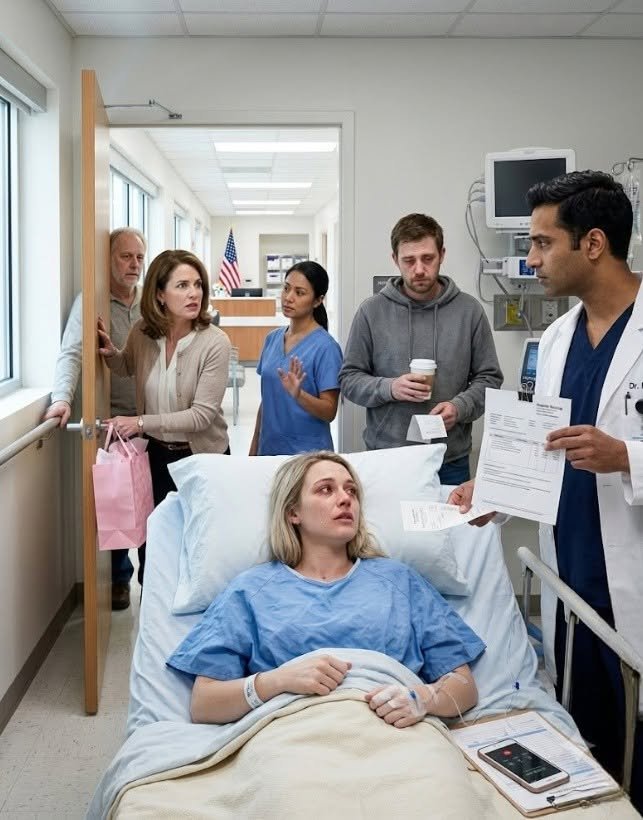
It was not.
Because we are taught that parents are permanent.
We are taught that mothers get more chances because they are mothers, and fathers get excuses when they are quiet, and daughters who draw boundaries are cruel.
But the monitor beside me was still beeping.
My wristband still had my name on it.
The incision under my blanket still burned.
I had seventeen missed calls that proved I had begged before I chose myself.
“No,” I said.
My mother’s mouth opened.
“No?”
I looked at the nurse.
“I don’t want them in here.”
The nurse did not hesitate.
She stepped into the doorway and said, “You heard the patient.”
My father looked like he might speak.
For one second, I wanted him to.
I wanted him to say he was sorry.
I wanted him to say he had been scared.
I wanted him to say he should have answered.
Instead, he looked at the floor.
My mother said my name the way she used to say it when I was a child and had embarrassed her in public.
“Holly Anne.”
I turned my face toward the window.
The hallway voices moved away.
The door closed.
The room became smaller and quieter.
Michael stood awkwardly near the wall, suddenly aware that he was inside a private moment he had never asked to enter.
“I can go,” he said.
I shook my head.
It hurt, but I did it anyway.
“Thank you,” I whispered.
His face softened.
“You scared the hell out of me,” he said.
It was such an ordinary sentence.
No speech.
No performance.
Just one tired person telling another tired person the truth.
That was the first moment I cried.
Not because my mother had failed me.
I already knew that.
I cried because someone who barely knew me had heard me fall and decided that was enough reason to come.
The security footage came up later that afternoon.
Hospital administration reviewed it with the patient advocate.
I did not watch the whole thing because Dr.
Reeves said stress was the last thing my body needed.
But the advocate told me what mattered.
At 9:16 a.m., my mother had stood at the nurses’ station and said, “If she misses this shower, Brooke will never forgive her.”
At 9:17 a.m., my father had said, “Maybe we should just see her first.”
At 9:18 a.m., my mother had replied, “Seeing her will only make this take longer.”
Those words became the line I could not unknow.
Not the unanswered calls.
Not even the discharge request.
That sentence.
Seeing her will only make this take longer.
I had been dying, and my mother had thought of me as a delay.
The hospital social worker helped me update my emergency contacts before I was discharged.
It was a simple form.
Name.
Relationship.
Phone number.
Authorization for medical updates.
I removed Eleanor Crawford.
I removed James Crawford.
My hand shook when I did it, but not because I was unsure.
It shook because sometimes freedom arrives after your body has already paid the price.
I put my coworker Ashley as my primary contact.
Then, after asking him three times if he was sure, I put Michael as secondary.
He did not make it weird.
He just said, “Okay.”
The day I went home, my apartment had been cleaned.
Not professionally.
Kindly.
The bathroom floor had been mopped.
The trash was out.
There was soup in the fridge, a pack of crackers on the counter, and a note from Ashley saying she had used the spare key from my desk drawer.
Michael had replaced the chain lock because the paramedics had bent it getting in.
He left the receipt for the lock under a magnet shaped like the Statue of Liberty that I had bought years ago from a thrift store.
The note beside it said, Don’t argue. Rest.
I did argue later.
He ignored me.
Brooke called three days after the shower.
I did not answer.
Then she texted.
Mom says you made everything about you.
Is that true?
I looked at the message for a long time.
Then I sent her three screenshots.
The seventeen calls.
Our mother’s text.
The hospital note from 9:18 a.m.
Brooke called again.
This time I answered.
She was crying before I said hello.
“I didn’t know,” she said.
I believed her.
Brooke could be spoiled and thoughtless, but she was not cruel in the way our mother was cruel.
She had been told I was stable.
She had been told I was being dramatic.
She had been told I wanted attention.
Our family had always worked that way.
My mother wrote the script, and everyone else performed until someone finally checked the paperwork.
Brooke went quiet when I told her about the discharge request.
Then she said, “I’m sorry.”
It did not fix anything.
But it was the first honest sentence anyone in my family had given me since 2:14 a.m.
My father came to my apartment two weeks later.
He stood in the hallway holding a paper grocery bag with soup containers inside.
Michael happened to be coming up the stairs at the same time and stopped when he saw him.
My father looked older than he had in the hospital.
See more on the next page
