
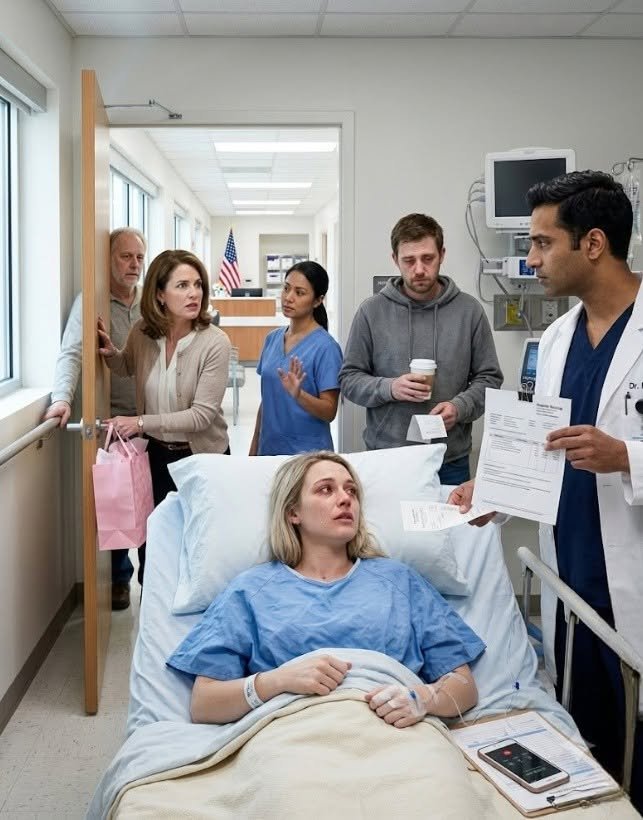
Everyone turned.
Michael Grant stood near the doorway in his gray hoodie, holding a paper coffee cup in one hand and a folded receipt in the other.
He looked exhausted.
His eyes were red, and his hair was flattened on one side like he had been running his hands through it all night.
He was not family.
He had no obligation to be there.
And still he was there.
My mother looked him up and down with the kind of disdain she reserved for people she thought she could dismiss quickly.
“Who are you?” she asked.
Michael stepped closer but did not raise his voice.
“The neighbor who heard her hit the floor.”
My father looked at me then.
Really looked.
For the first time since I woke up, his face changed.
Michael lifted the receipt slightly.
“And the one who paid what billing asked for because nobody else in her emergency contacts was answering.”
Silence filled the doorway.
Hospital silence is different from home silence.
It has machines inside it.
Footsteps.
Plastic curtains.
A cart squeaking somewhere far away.
But in that moment, all of it seemed to fall behind the sound of my mother breathing through her nose.
Dr.
Reeves looked at me.
“Holly,” he said gently, “do you know a man named Michael Grant?”
I nodded once.
“He lives across the hall.”
My mother gave a small, humorless laugh.
“Well, this is inappropriate.”
Michael looked at her.
“No,” he said. “Leaving her on the floor was inappropriate.”
My father whispered, “Eleanor.”
It was not a warning.
It was something weaker.
A plea for her to stop before she made it worse.
She did not stop.
“You have no idea what this family has going on,” she snapped.
“My older daughter is due soon. We had seventy people coming.
Do you know what it takes to organize—”
“A baby shower?” Michael asked.
The nurse looked away.
Dr. Reeves’s jaw tightened.
My mother’s face flushed.
Then the patient advocate arrived.
She was a woman with a blue folder tucked against her chest and the careful expression of someone who had seen too many families behave badly under fluorescent lights.
“Ms.
Crawford,” she said to me, “I need to confirm something with you when you feel able.”
My mother immediately reached for the folder.
The advocate pulled it back.
“No, ma’am.”
That was when I noticed the label on the top sheet.
Patient Discharge Against Medical Advice Request.
Beneath it was the 9:18 a.m. note Dr.
Reeves had mentioned.
And beneath that was another form.
My name was typed on the patient line.
My mother’s signature sat at the bottom.
The heading made my mouth go dry.
Financial Responsibility Transfer Authorization.
I did not understand at first.
Pain and medication made the words swim.
The advocate explained quietly.
“It appears your mother attempted to sign a document stating that you accepted full financial responsibility for any consequences of leaving against medical advice.”
I stared at my mother.
She lifted her chin.
“It was just paperwork.”
Paperwork.
A plan.
A signature.
A way to wash her hands and leave mine holding the bill.
My father gripped the wall rail.
His knuckles went pale.
“Eleanor,” he whispered, “what did you do?”
My mother rounded on him.
“I was trying to fix a problem.”
“I was the problem?” I asked.
My voice was thin, but it carried.
For the first time, she looked directly at me.
Not at the monitors.
Not at the chart.
Not at the nurse blocking the door.
At me.
“You have no idea how hard this weekend has been,” she said.
Something in my chest cracked open, but not the way she expected.
It did not make me smaller.
It made me done.
Michael set the receipt on the rolling bedside table.
Then he looked at the patient advocate.
“There’s one more thing,” he said.
My mother stiffened.
The advocate’s eyes moved to him.
Michael pointed toward the hallway ceiling.
“When Mrs. Crawford was at the nurses’ station, she said something about Holly’s apartment.
I think the security camera caught it.”
My mother’s face drained.
All the color went out of her cheeks so fast that even my father noticed.
“What did you say?” he asked.
She did not answer.
The patient advocate closed the folder slowly.
“I think,” she said, “we should continue this conversation with hospital administration present.”
My mother tried to laugh.
It came out wrong.
Dr. Reeves stepped closer to my bed.
“Holly, do you want your parents in this room?”
The question should have been easy.
See more on the next page
