
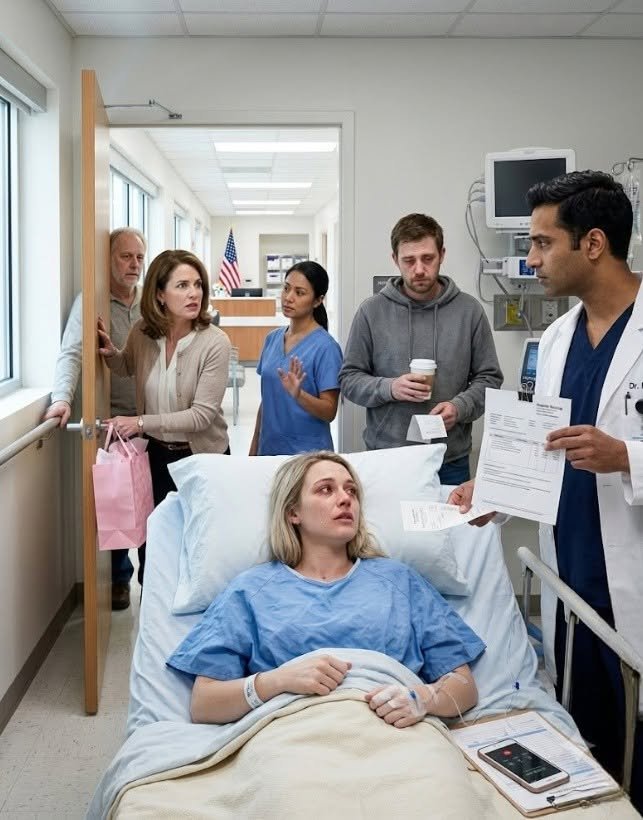
I stared at him.
“She went to the nurses’ station and asked how soon you could be discharged.”
The monitor beside me quickened.
Dr.
Reeves kept his voice calm.
“She said there was a family event. She said you had a history of being dramatic about pain.
She suggested you could recover at home if we prescribed oral antibiotics.”
I could picture her perfectly.
My mother in her nice cardigan.
Hair sprayed.
Purse tucked under one arm.
Voice lowered in that polished way she used when she wanted strangers to think she was reasonable.
I had heard that voice at parent-teacher conferences, church potlucks, and front desks.
It was the voice she used when she wanted to make someone else sound unstable.
I did not scream.
I did not cry at first.
For one ugly heartbeat, I wanted to rip the IV out and walk into the hallway just to make her look at what she had almost missed.
But my body could barely lift a hand.
So I lay there while Dr. Reeves held my chart like evidence.
Because it was evidence.
“Hospital administration documented the request,” he said.
“The charge nurse entered a note at 9:18 a.m. stating that the patient’s mother requested early discharge against medical advice.
The request was refused.”
The words settled slowly.
Against medical advice.
That phrase meant something.
It meant my mother had not misunderstood.
It meant someone had explained that I was sick enough to stay, and she had still pushed.
“What about my dad?” I asked.
Dr. Reeves paused.
“He was with her.”
That hurt in a quieter place.
My father had never been cruel in the obvious ways.
He was soft-spoken.
He fixed things.
He changed my oil when I was nineteen and broke.
He once drove to my apartment in the rain because my smoke detector would not stop chirping.
But quiet can still be a choice.
That morning, his choice had been to stand next to my mother while she tried to send me home half-poisoned because Brooke’s baby shower had folding chairs and cupcakes waiting.
“Are they still here?” I asked.
The nurse looked toward the door.
“Yes,” Dr.
Reeves said. “They’ve been told they cannot make medical decisions for you.
You are an adult. You are conscious.
You are our patient.”
I closed my eyes.
That should have been enough.
Then he said, “There is also the matter of your bill.”
Money found me even there.
Even under hospital blankets.
Even with stitches in my abdomen and antibiotics dripping into my arm.
I had insurance through work, but it was not good insurance.
The deductible alone made my stomach twist, and my stomach was already full of fresh incisions.
“The ambulance,” I whispered.
“We have your insurance information,” he said. “That isn’t what I mean.”
He pulled a clipped paper from the folder.
“A man came to the hospital earlier.
He paid the immediate balance requested by billing and asked that no financial pressure be placed on you while you recover.”
I frowned.
“A man?”
“He gave his name to the intake desk,” Dr. Reeves said.
“He also spoke with the patient advocate.”
I searched my mind.
Coworkers.
Old classmates.
Neighbors.
No one fit.
My mother’s voice rose outside the door before I could ask more.
“She is my daughter. I have a right to speak to her.”
The nurse stepped toward the doorway.
Another voice answered from the hall, calm but firm.
“Ma’am, you need to step back.”
Then my father said something too low for me to hear.
Dr.
Reeves turned slightly, but my eyes stayed on the paper in his hand.
“Who paid it?” I whispered.
Before he answered, the door pushed open just enough for my mother’s face to appear.
Her hair was curled.
Her makeup was done.
A pale pink gift bag hung from her wrist, tissue paper blooming from the top.
It looked like a cruel little flag from another world.
“Holly,” she said, more annoyed than afraid, “we need to talk about how you embarrassed this family.”
The nurse moved between us.
“Mrs. Crawford, step back.”
My mother ignored her.
“You called seventeen times in the middle of the night,” she said.
“Your sister is already stressed. Do you understand what this did to her?”
I looked at the gift bag.
I looked at my mother’s curled hair.
I looked at my own wristband.
Something inside me went still.
Not anger.
Worse than anger.
Clarity.
Dr.
Reeves’s voice cut through the room.
“Mrs. Crawford, your daughter was in critical condition.”
My mother’s mouth tightened.
“I understand that, but she has always had a flair for—”
“For dying?”
The words came from the hallway.
See more on the next page
