
Not sick.
Just exposed.
“I should have answered,” he said.
I stood in my doorway with one hand braced against the frame because standing too long still pulled at my stitches.
“Yes,” I said.
He swallowed.
“I should have stopped her.”
“Yes.”
He looked down at the grocery bag.
“Can I come in?”
That was the part people think forgiveness is supposed to make easy.
It did not.
Love does not erase a 9:18 a.m. note.
Apology does not erase seventeen calls.
Soup does not erase a signature.
“No,” I said.
His face folded a little.
I almost softened.
Then I remembered the bathroom tile.
I remembered the phone ringing.
I remembered my mother saying seeing me would only make things take longer.
“You can leave the bag,” I said.
“But you can’t come in.”
He nodded.
It was not a happy ending.
Real boundaries rarely feel happy at first.
They feel like standing in a doorway with your whole past on one side and your pulse still proving you survived on the other.
My mother did not apologize.
She sent one long message about stress, reputation, Brooke’s pregnancy, and how hurtful it was that I had allowed strangers to judge her during a difficult family weekend.
I did not respond.
Then she sent another.
Then she called.
Then she had relatives call.
I saved everything in a folder on my phone.
Screenshots.
Voicemails.
Dates.
Times.
Not because I planned revenge.
Because after years of being told I remembered things wrong, documentation felt like oxygen.
Dr. Reeves cleared me to return to work six weeks later.
The scar on my abdomen faded slowly.
The hospital bills did not disappear, but the worst immediate pressure had been handled.
I set up a payment plan for what remained.
Michael refused to let me pay him back all at once.
He wrote the amount on a piece of paper, divided it into tiny monthly payments, and said, “There.
Now you can stop looking like you’re about to fight me in the hallway.”
I laughed for the first time without it hurting.
Months later, Brooke had the baby.
She sent a picture.
A small red face.
A hospital blanket.
Her hand curled protectively around her daughter’s tiny foot.
Under the photo, she wrote, I understand more now.
I looked at that baby and hoped she would grow up in a family where pain did not have to compete with party decorations.
I hoped Brooke would become the kind of mother who answered.
As for me, I still think about that night when my phone rings after midnight.
My body remembers before my mind does.
The cold tile.
The buzzing light.
The seventeen calls.
But I remember something else too.
A knock at the door.
A neighbor’s voice in the hall.
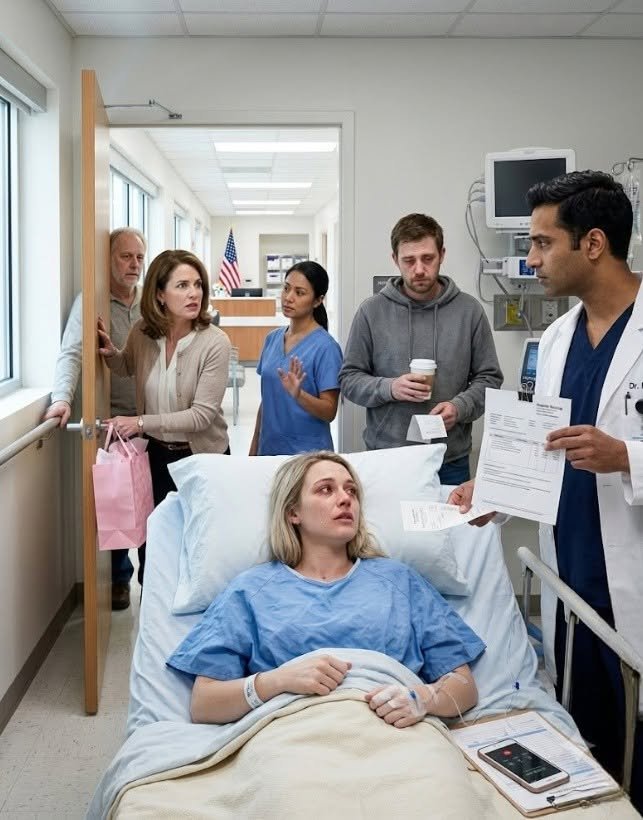
A surgeon holding my chart like proof that I had not imagined the cruelty.
A nurse stepping between me and the woman who called herself my mother.
An entire hospital room teaching me that family is not always the person who gave you your name.
Sometimes family is the person who hears you fall and comes running.
Sometimes betrayal sounds like a phone no one intends to answer.
And sometimes love sounds like a stranger saying your name through a locked door, refusing to let the silence win.
See more on the next page
