
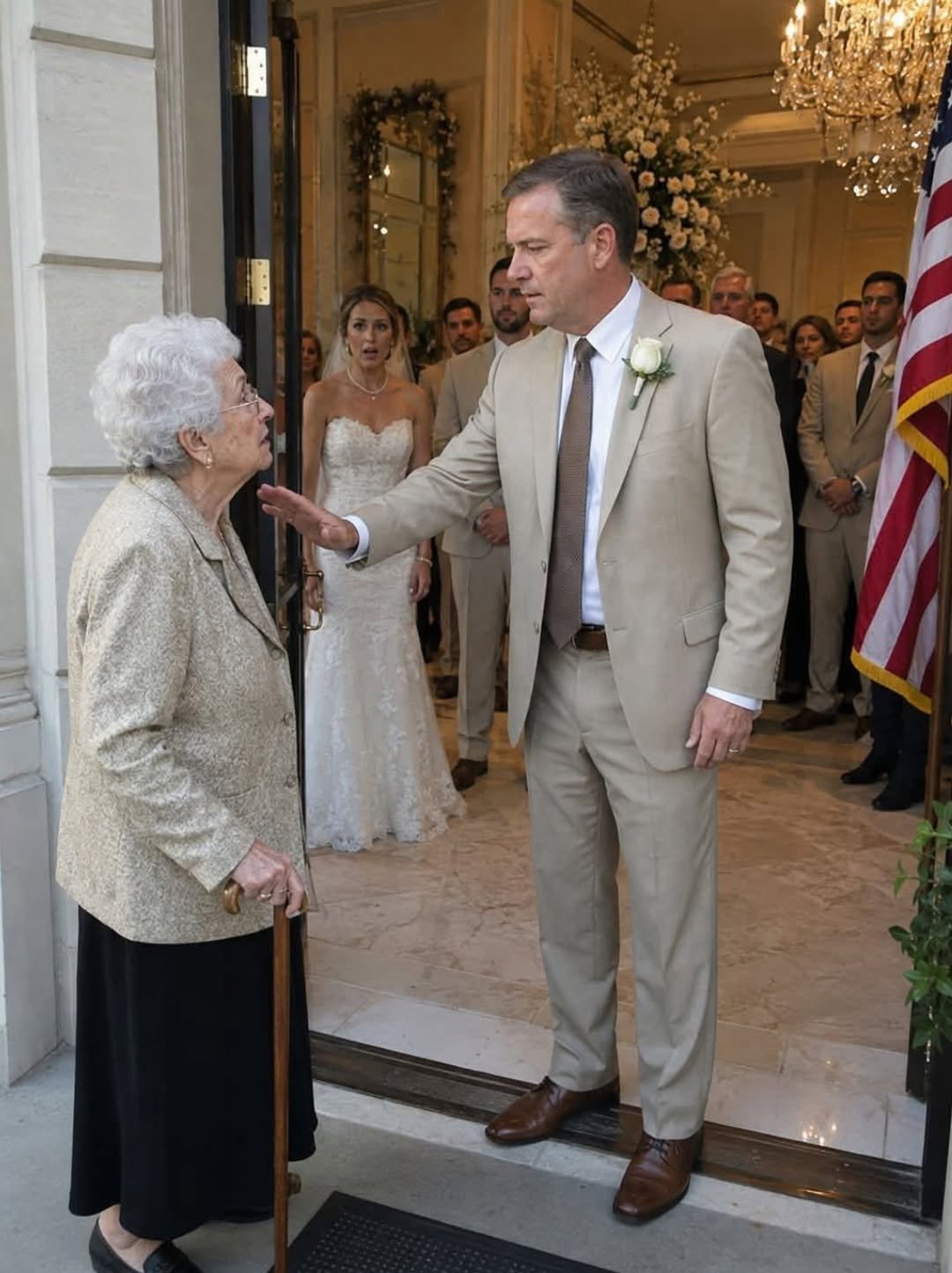
He almost laughed.
“No,” he said. “I don’t suppose you are.”
The mediation was in November.
Robert had suggested it as a way of potentially resolving the matter without a full trial, and Dawkins had agreed, which Robert said was a signal that their confidence in the case had declined since the motion to dismiss failed.
I sat across a table from Gerald for the first time since the wedding.
He looked at the table.
He did not look at me for the first twenty minutes.
The mediator was a retired judge named Williams who had the patience of someone who has seen many disputes and who understood that patience was the most useful thing she could bring to a room.
After the opening statements, the mediator asked each party to describe what they wanted.
Robert, on my behalf, said: full reimbursement of the documented costs, plus legal fees.
Dawkins, on Gerald’s behalf, said: a settlement figure that acknowledged the confusion while protecting the financial position of his clients.
The mediator then asked Gerald directly: “Is there anything you’d like to say to your mother?”
Gerald looked at his hands.
He said: “I made a mistake.”
This was the second time he had used that word.
I said, quietly: “Tell me what the mistake was.”
He looked up.
“I let the list be done wrong,” he said.
“Gerald,” I said. “We are not children. I am not interested in managing. I want to know: was my name taken off the list deliberately, or was it never put on in the first place?”
He did not answer immediately.
Catherine, who was seated beside him, touched his arm.
He said: “It wasn’t put on.”
“By whom?” I said.
“By me,” he said.
“Why?” I said.
This was the question Robert had told me I would probably not get answered. He said that people in these situations rarely tell you why because they do not understand why themselves, or because the why is something they cannot say out loud.
Gerald said: “Catherine’s family was sitting at the front. The arrangements were complicated. It was easier to have fewer people to worry about.”
I sat with this.
Fewer people to worry about.
That was the sentence.
I had been, in my son’s wedding planning calculus, a person to worry about. Someone requiring management. An inconvenience to be simplified out of the arrangement.
The woman who had signed the checks.
The mediator asked Gerald whether he understood why the situation had resulted in legal proceedings.
He said yes.
She asked whether he was prepared to offer something meaningful.
His attorney leaned toward him.
Gerald said: “I’ll pay back what she spent.”
“All of it?” the mediator said.
“All of it,” he said. “The documented amounts.”
“And legal fees?” the mediator asked.
Gerald looked at his attorney.
Dawkins said: “We’ll discuss an amount for legal fees.”
The mediation produced an agreement.
Full reimbursement of the fifty nine thousand, three hundred dollars.
Sixty percent of my legal fees, which came to an additional amount Robert and Dawkins settled on.
A written acknowledgment, which I had insisted on and which Gerald’s attorney had resisted and which the mediator had supported, that my name had not been placed on the guest list for the event and that the payments I had made were not gifts but contributions toward the event.
The acknowledgment was not an apology.
I had not asked for an apology because apologies, in my experience, are only useful when they are genuine, and I did not believe that a mediated apology would be genuine.
What I had was the acknowledgment. The factual statement of what occurred.
Robert called me that evening.
“It’s done,” he said.
“Thank you,” I said.
“You did most of the work,” he said. “You kept every receipt.”
“James always said paperwork was how you respected the arrangements you made,” I said.
“He was right,” Robert said.
After the call, I sat in the study again.
The folder was still on the desk. It had lived on the desk since the night I came home from the wedding. In the months since, it had accumulated additional documents: the demand letter, the correspondence, the mediation agreement.
I put it all in order.
I filed it.
I did not feel triumphant.
That is the thing that people do not tell you about these situations: when they are resolved, the resolution does not feel like victory. It feels like the closing of something that should never have been open.
My son had not put my name on the guest list.
He had accepted sixty thousand dollars and had managed me out of the event.
The settlement meant he had paid for that.
It did not mean it had not happened.
I picked up my phone and called Patricia, Eleanor’s sister from the Savannah story, but that is a different Eleanor.
I called my friend Margaret.
She said: “How did it go?”
I said: “It went the way these things go.”
She said: “Did he pay?”
“He paid,” I said.
“Good,” she said. “And how are you?”
I thought about the candlelit tables and the white flowers and the gold lighting and the strings warming up inside the courtyard.
“I’m deciding what kind of relationship I want with my son,” I said. “I haven’t decided yet.”
“That’s fair,” she said.
“I’m also going to send Rachel her trust distribution,” I said. “She’s entitled to it. Her marriage is a good one. I am glad for her.”
“Does she know about the trust?”
“Vaguely,” I said. “She’ll know the specifics when I see her for Christmas.”
“Are you having Christmas?” Margaret said.
“Rachel and Daniel are coming here,” I said. “Gerald and Catherine will go where they go. I did not invite them.”
“That seems right,” she said.
“I thought so,” I said.
We talked for another hour, about other things, the things that people who have known each other for decades talk about when the immediate crisis has passed: the garden, the book Margaret was reading, a restaurant she had tried, her granddaughter who was starting university.
The ordinary things.
After the call, I locked the study and went to bed.
I lay in the dark for a while.
I thought about the dress, the pale pink I had saved for something important, still in the dry cleaner’s bag because I had not yet decided what to do with it.
I thought about stepping out of the car in Savannah with the gravel crunching softly under my heels and the late afternoon air heavy with garden roses and the strings warming up inside.
I had believed that occasion belonged to me.
It had not, in the end, been what I believed it was.
But Rachel’s marriage was still Rachel’s marriage.
Whatever Gerald had done did not change the fact of that.
She was married to a careful man who talked about urban planning and who called me Eleanor without hesitation.
She had come to dinner and had stayed the evening and had hugged me at the door.
This was what was mine.
Not the occasion.
The relationship.
That had not been taken.
That was not something Gerald had the power to take.
I am seventy three years old.
I have learned the difference between the occasion and the thing itself.
The dress is at the dry cleaner.
I am going to pick it up.
I have another occasion coming.
This time I will be in the room.
That is the whole of it.
That is enough.
That has always been enough.
I want to tell you about Christmas, and about what happened after.
Rachel and Daniel arrived on Christmas Eve in the late afternoon.
I had been cooking since morning: the things I made for Christmas, which were the things my mother had made and her mother before her, the recipes that required most of the day and that filled the house with the specific smell of the season.
Daniel brought wine and Rachel brought the flowers, which is the appropriate division of labor, and they both came into the kitchen and stayed there while I finished, which is the right thing to do in someone’s kitchen on Christmas Eve.
We talked about their first months in the apartment. They were still figuring out the neighborhood, which was on the east side of Atlanta, and Rachel had found a yoga studio and Daniel had found a coffee shop with a good table near the window where he went when he needed to think.
I liked hearing these details.
This is what grandmothers are for, or part of it: to be the person who wants the details. Who asks which coffee shop and what does the table look like and which direction does the window face.
The window faces west, Daniel said. In the afternoon the light is very good.
After dinner, we sat in the living room with the tree lit and the fire going, which is the best possible room in winter, and Rachel asked me about the settlement.
She had been updated by Robert, at my request and with the settlement agreement’s provision that I could share the outcome with family members, and she knew the amount and the acknowledgment and the general shape of what had been resolved.
She said: “Grandma. How do you feel about it?”
I thought about this.
“Resolved,” I said. “Not healed. Resolved.”
“Is there a difference?” Daniel asked.
“Resolved means the legal matter is concluded,” I said. “Healed would mean I have stopped feeling the grief of it. I don’t think that happens as quickly.”
“Do you think it will?” Rachel said.
“I think the grief will change,” I said. “It has already. In June it was acute. Now it is the kind of grief that sits in the background and doesn’t stop you from doing things but doesn’t fully go away either.”
Rachel was quiet.
Then she said: “I had a conversation with my dad.”
I looked at her.
“In October,” she said. “I went to their house without telling Daniel because I needed to do it alone.”
“What did you say?” I said.
“I said that I knew what had happened,” she said. “I said I knew about the money and about your name not being on the list and about the settlement. I said I needed to understand why.”
“What did he say?” I said.
She was quiet for a moment.
“He said he didn’t want you there,” she said.
She said it directly, which is the Rachel I have always known: the woman who tells you the hard things without softening them into something easier.
“Why not?” I said.
“He said you made him feel judged,” she said. “He said whenever you were in a room with him you were taking notes. Evaluating him.”
I sat with this.
“I was keeping records,” I said. “Not judging him.”
“I know,” she said. “I told him that.”
“What did he say?”
“He said it felt the same to him,” she said.
I thought about this.
I am a woman who keeps records. I print things. I save every invoice and email confirmation. I make notes in a notebook about my own life. I taught my children that paperwork was how you respected your arrangements.
Gerald had experienced this as judgment.
As a watching without warmth.
I had not intended judgment.
I had intended clarity.
Whether the intention matters when the experience is different is a question I did not fully know the answer to.
“Did he understand,” I said, “that the consequence of not wanting me there was that I paid for something and was excluded from it?”
“I told him,” she said. “He said he thought you’d understand.”
“Understand what?” I said.
“That he needed it to be his event,” she said. “That he needed to feel like he was the one giving something.”
I sat with this for a long time.
My son, who had accepted sixty thousand dollars from me, had needed to feel like he was the one giving something.
He had taken my money and given his wife’s family the front seats and left my name off the list so that the occasion would feel like it was his.
He had built himself as the host of an event I had funded and had set me outside the door so the illusion would hold.
I understood this.
I did not forgive it.
But I understood it.
“Rachel,” I said.
“Yes.”
“How are you?” I said. Not about this. Not about the conversation with Gerald. About the larger question of who she was and where she was and whether she was well.
She looked at me.
She understood the question.
“I’m okay,” she said. “I’m figuring out what my relationship with my parents looks like now that I understand some things about them that I didn’t understand before.”
“How is that going?” I said.
“Slowly,” she said. “I love them. I’m also angry at them. Both of those things are true at the same time and I don’t know yet how to hold them.”
“That’s an honest answer,” I said.
“I’m trying to be honest,” she said.
“Good,” I said.
Daniel, who had been quiet for most of this, said: “I think the thing I keep coming back to is that you came to the entrance in a pink dress and said it’s okay, son, and went home and called your lawyer.”
See more on the next page
