
The Folder
My lawyer’s name is Robert Chen, and he has been my lawyer for twenty two years.
He answered on the second ring, which is how Robert answers when he sees it is me: on the second ring, having given himself one beat to orient himself. This is a habit I have always found reassuring.
I told him what had happened.
I told it in the way I tell things: in order, with the relevant specifics, without editorializing until I had finished the facts.
Robert was quiet through most of it.
When I finished, he said: “Eleanor.”
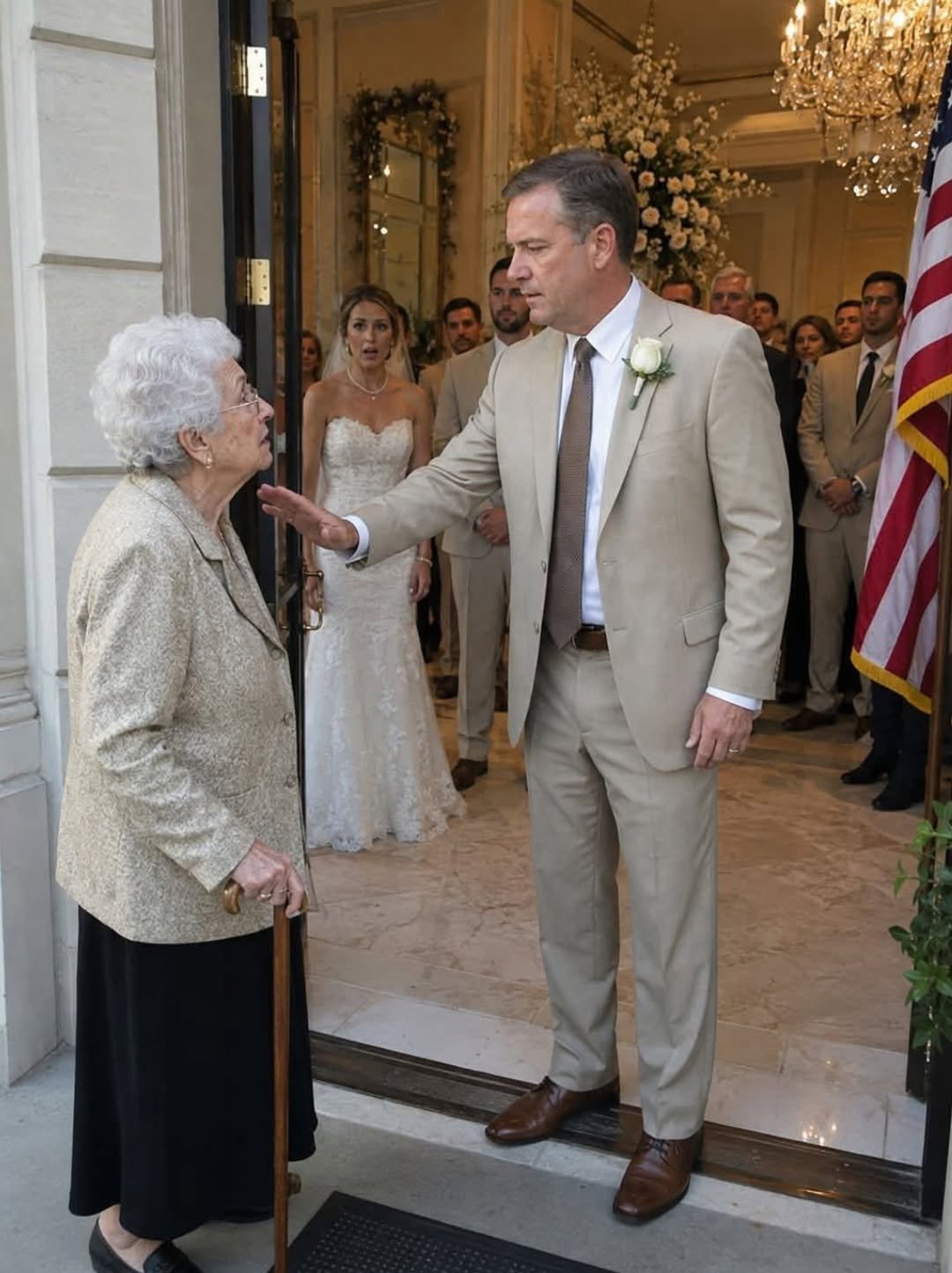
My name is Eleanor Whitmore. I am seventy three years old. I am the widow of James Whitmore, who died eleven years ago and who left behind a well-organized estate, three children, a house in Savannah, and a grandchild named Rachel who was married today in a ceremony I paid for and was stopped at the door of.
My son’s name is Gerald. He is fifty one years old. He has a wife named Catherine and three children, of whom Rachel is the eldest.
“Yes,” I said.
“Are you all right?” he said.
“I’m decided,” I said.
He knew what this meant. Robert has known me for twenty two years. He understood the difference between my distressed voice and my decided voice, and he understood that decided, in my vocabulary, meant I had moved through the distress and arrived somewhere that required action rather than sympathy.
“The folder,” he said.
“I have it in front of me,” I said.
“Tell me what’s in it.”
I went through it with him.
The folder contained the following: the original contract with the hotel for venue rental and catering, signed by me with my personal check as deposit; the invoice from the floral designer, paid in full from my account; the invoice from the string quartet, paid in full; the invoice from the photographer, fifty percent deposit paid by me with balance to be paid after the event; the seating chart correspondence, which was in my email but which I had printed because I print everything of consequence; the receipt for my dress; and the final transfer confirmation from my bank to Gerald’s household account for an amount we had agreed upon at the beginning of planning as the “family contribution” to expenses I was not paying directly.
The direct payments I had made totaled forty seven thousand, three hundred dollars.
The transfer to Gerald was twelve thousand dollars.
Total: fifty nine thousand, three hundred dollars.
Robert was quiet while I read him these figures.
Then he said: “Were any of these amounts formalized in a written agreement?”
“The hotel contract is in my name,” I said. “The florist invoice is in my name. The quartet and the photographer invoices are in my name. The transfer to Gerald was accompanied by an email I sent him which he replied to confirming the purpose.”
“What did the email say?” he said.
“I said: attached is the transfer for the family portion of Rachel’s wedding expenses. Please confirm receipt and the specific costs it will cover. He replied: received, this covers the catering upgrades and the rehearsal dinner.”
“He confirmed the purpose in writing,” Robert said.
“Yes,” I said.
“Do you still have that email chain?”
“I printed it,” I said.
“Of course you did,” he said.
This is one of the things Robert and I understand about each other: I print things. James used to say I was the only person he knew who had a hard copy of her own wedding vows, which was true, and which he said with affection.
“Eleanor,” Robert said. “What do you want to happen?”
This is the question he always asks before he says anything else. Not what are your legal options or what do you think you’re owed but what do you want to happen. He says it’s the most important question and that lawyers who skip it cause problems for themselves and their clients.
I thought about it.
“I want Gerald to understand what he has done,” I said. “Not in a private conversation where he can manage it. On record. In a way he cannot dismiss.”
“Okay,” he said. “And the money?”
“The money is secondary,” I said. “But not irrelevant.”
“Give me a few hours tonight,” he said. “I want to review everything carefully before we draft anything. Can I call you in the morning?”
“Yes,” I said.
“Go to sleep if you can,” he said.
“I don’t intend to spend the night weeping,” I said.
“I know you don’t,” he said. “That wasn’t what I meant.”
I put the phone down.
I made tea.
I sat in the study with the folder open on the desk and the tea and the dark garden visible through the window and I thought about my granddaughter.
Rachel is twenty six years old. She has her grandfather’s eyes and my mother’s stubbornness, which skipped a generation. I have known her since the morning she was born, when Gerald called me from the hospital with the particular voice of a new parent who cannot quite believe what has happened to them.
I have been present for every significant event of her life: birthday parties, school plays, the science fair where she won with a project about water purification that I had helped her research but that she had built entirely herself, the graduation from Clemson, the first job, the apartment.
I had met her fiancé, Daniel, twice before the engagement, and both times I had thought: this is a careful person. Someone who thinks before he speaks.
I did not know whether Rachel knew what happened at the entrance.
I did not know whether she had known my name was not on the list or whether this had been done without her knowledge.
This was the thing I could not resolve, sitting in the study with the tea.
I did not want to damage Rachel’s wedding day more than it had already been damaged. Whatever happened between Gerald and me was between Gerald and me. Rachel’s marriage was separate.
But the not knowing sat with me.
Robert called at eight the following morning.
He had been busy overnight. I could tell from his voice, which had the quality it gets when he has been working: slightly compressed, more efficient than usual.
“I’ve drafted three documents,” he said. “Let me walk you through them.”
The first document was a formal demand letter.
It was addressed to Gerald and Catherine and set out the following: the amounts I had paid directly toward Rachel’s wedding and the amounts I had transferred to their household account, with documentation references; the fact that I had been stopped at the entrance to the event I had funded; and a demand for full reimbursement of the fifty nine thousand, three hundred dollars within thirty days.
Robert said: “I want to be honest with you about this. The direct payments are cleaner than the transfer. The hotel, the florist, the quartet, the photographer — all in your name, all documented. The transfer is more complicated because it was characterized as a gift.”
“His email confirmation characterized it as payment for specific expenses,” I said.
“Which helps,” he said. “It changes the character of the payment from a voluntary gift to a reimbursement of agreed expenses. But their attorney, if they get one, will argue gift. I think we have a reasonable case. I don’t think it’s certain.”
“What’s the total we’re more confident about?” I said.
“The direct payments,” he said. “Forty seven thousand, three hundred. Those are clearly documented costs that you incurred and that you now have cause to argue were incurred under false premises, meaning the premise that you would be included in the event.”
“A legal premise?” I said.
“An implied contract,” he said. “You paid for services in connection with an event. The payment implies an expectation of participation. Their exclusion of you from that event could be characterized as a breach of the implied understanding.”
“Can that argument succeed?” I said.
“It depends on the judge,” he said. “Implied contract law is not simple. What I think is more useful is what the demand letter itself does, even if we never file a suit.”
“What does it do?” I said.
“It makes a formal record,” he said. “It requires a response. It documents your position clearly and contemporaneously. Even if Gerald refuses to pay and we don’t pursue it, you have a letter on file that states what happened, when, and what you spent.”
“What are the other two documents?” I said.
“The second,” he said, “is a letter to Rachel. I want you to read it before we send it, and you may not want to send it at all. I drafted it because I thought you might want to have the option.”
“What does it say?”
“It is addressed to Rachel directly and it explains, factually and without editorializing, that you were stopped at the entrance to her wedding by her father, that your name was not on the guest list, and that you spent sixty thousand dollars contributing to an event you were excluded from. It does not make demands. It simply states what happened and gives Rachel the opportunity to understand it from your perspective rather than her father’s.”
I held this.
“You said I might not want to send it,” I said.
“Yes,” he said. “Because Rachel is your granddaughter and she was getting married that day and whatever is between you and Gerald is between you and Gerald. You know her better than I do. I leave it to you.”
“And the third document?”
“The third is a notice to the estate trustee,” he said. “I want to explain this carefully.”
James’s estate had been structured with a trust for the grandchildren, which I administered as trustee. The trust was designed to distribute funds at specified milestones: college graduation, marriage, and age thirty. Rachel’s marriage today would trigger the marriage distribution, which was forty thousand dollars.
“I am not suggesting you withhold Rachel’s distribution,” Robert said immediately. “Rachel is entitled to that money. It belongs to her. I would not advise you to use it as leverage and I don’t think you would want to.”
“No,” I said.
“What the notice does is document, for the trust record, that the trustee was excluded from the beneficiary’s marriage event and that this is being noted in the trustee’s log. It doesn’t alter anything. It simply creates a formal note in the trust file that this event occurred on this date.”
“Why?” I said.
“Because if Gerald ever challenges your administration of the trust, for any reason, you want a contemporaneous record of your relationship with the beneficiaries and with Gerald at this time,” he said. “It’s protective documentation.”
“Gerald is not a beneficiary of the trust,” I said.
“No,” he said. “But he is Rachel’s father and a potential influencer of any future challenge. I’m being cautious.”
“Do all three,” I said.
Robert sent the demand letter to Gerald and Catherine by courier that morning, requiring signature of receipt.
He sent the letter to Rachel by email with a note that it was from her grandmother’s lawyer and that she should read it when she was ready and that she did not need to respond unless she chose to.
He entered the note in the trust file.
Then he called me to confirm.
“It’s done,” he said.
“Thank you,” I said.
“What would you like to do now?” he said.
“Wait,” I said.
Gerald called me at noon.
I did not answer.
He called again at twelve forty five.
I did not answer.
He texted at one: Mom please call me.
I put my phone down and went to the garden.
The garden in late June in Savannah is a complicated thing: the heat is already pressing and the roses are past their best and the jasmine on the south fence is having one last effort before the summer takes it. I walked the perimeter in my slippers, which I would not normally do, and I let the garden be what it was.
I thought about Gerald.
He had been a good boy. This is the thing that makes everything harder: he had been a good boy, attentive and proud in the specific way of first children, who understand early that their parents have expectations and who work to meet them. He had been a good student, a good husband to Catherine in the years when that was still true, a careful father to his children.
He had also, in the past decade, become someone who managed me.
This is the word I kept returning to: managed.
He managed my invitations to family events, which were regular but never spontaneous, never the let’s just come over that had existed when the grandchildren were small. He managed the information I received, so that I often learned things about Rachel and her siblings from other people before Gerald told me himself. He managed his wife Catherine’s relationship with me, which had cooled significantly in the past five years in ways I had attributed to Catherine and was now rethinking.
When I offered to pay for the wedding, he had accepted in the managed way: formally, with a list of what would be needed, with the transfer instructions, with the confirmatory email. Not warmly. Not with the gratitude that a son might show a mother who was offering sixty thousand dollars. But managed, organized, transactional.
I should have understood what I was looking at.
The phone rang again at two.
This time it was Catherine.
I answered, because Catherine and I had a different history and because I was curious.
“Eleanor,” she said. Her voice had the tightness of someone who has been given a script and is finding it hard to follow.
“Catherine,” I said.
“We received the letter,” she said.
“Yes,” I said.
“We want to talk to you,” she said.
“You can talk to Robert,” I said.
“This is a family matter,” she said.
“It stopped being a private family matter when Gerald stopped me at the entrance,” I said. “In front of two hundred people.”
She was quiet.
“He didn’t mean it,” she said.
“Catherine,” I said. “Whose idea was it to leave my name off the list?”
A long pause.
“I don’t know what you mean,” she said.
“I mean: who decided that Eleanor Whitmore would not be on the guest list for the wedding she paid for?”
“There was a mix-up—”
“It wasn’t a mix-up,” I said. “Gerald called it a mistake on the day. Now you’re calling it a mix-up. These are two different words for the same thing, which is that neither of you wants to say plainly what was done.”
She was very quiet.
“He’s your son,” she said finally. “He’s Rachel’s father.”
“Yes,” I said. “He is both of those things. And I am his mother and Rachel’s grandmother, and I paid sixty thousand dollars toward a wedding I was turned away from.”
“Nobody turned you away—”
“My name was not on the guest list,” I said. “What is the word you would use?”
No answer.
“Talk to Robert,” I said.
I ended the call.
I went back inside and made lunch, because I had not eaten since the morning and because anger, in my experience, does not benefit from an empty stomach. I made a salad from what was in the refrigerator and I ate it at the kitchen table with the radio on, listening to the gardening programme that came on Sunday afternoons, and I let myself feel, briefly and thoroughly, the specific grief of being excluded by your own family from something you built.
See more on the next page
