
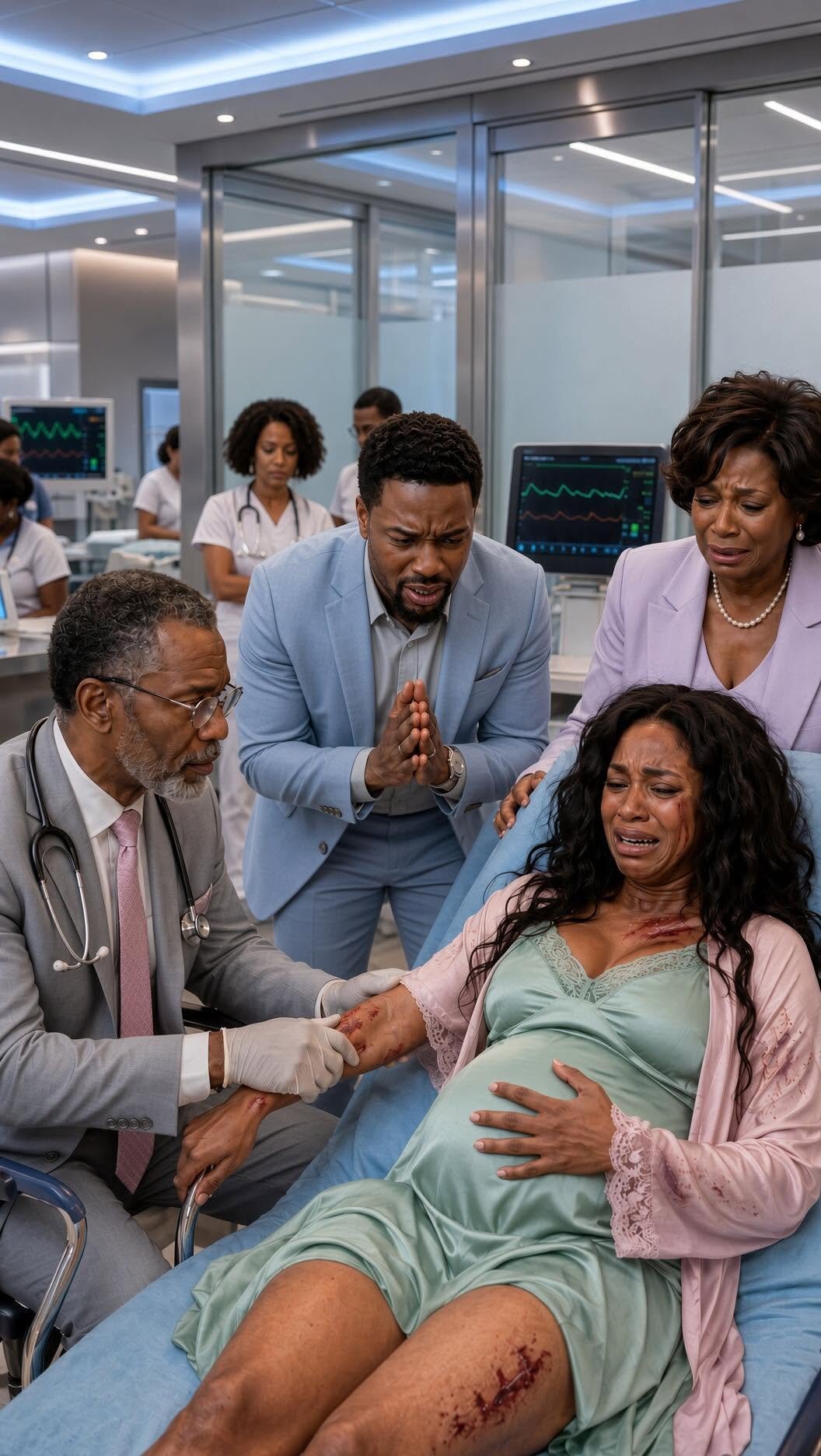
PART 21
Three months after the hospital, I returned to the house with
appropriate support to collect personal belongings.
The kitchen had been cleaned.
The floor looked ordinary.
That offended me at first.
Then I realized ordinary surfaces are allowed to survive terrible
events.
I walked to the camera.
A tiny dark lens near the upper cabinet.
Daniel had lived beneath it for months and never noticed.
Not because it was impossibly hidden.
Because he had stopped imagining I was capable of acting without his
permission.
Arrogance had done more work than technology.
Therapy helped me understand that my legal expertise had actually
complicated my shame. I believed I should have recognized manipulation
sooner because I had spent years studying deception. But professional
knowledge does not remove emotional attachment, dependency, hope, or
gradual normalization. I stopped treating my delayed recognition as
evidence against my intelligence.
PART 22
I found one of my father’s old fountain pens in the office.
Daniel had used it.
That detail made me angrier than the furniture or accounts.
Dad gave me the pen when I won my first major fraud case.
He said:
“Documents tell stories, Claire. Make sure you know who wrote them.”
I sat in the office holding that pen and finally understood how
completely I had abandoned my own instincts.
Not because I was foolish.
Because coercion had happened one concession at a time.
Daniel never asked me on our wedding day to surrender control of my
life.
He trained me gradually to treat every boundary as evidence I did not
love him enough.
Therapy helped me understand that my legal expertise had actually
complicated my shame. I believed I should have recognized manipulation
sooner because I had spent years studying deception. But professional
knowledge does not remove emotional attachment, dependency, hope, or
gradual normalization. I stopped treating my delayed recognition as
evidence against my intelligence.
PART 23
The financial case did not end with a single courtroom confession.
Months of review followed.
Some allegations were substantiated by records.
Others were narrowed.
The attempted trust transaction had been stopped.
Other transfers became subjects of civil claims and, where appropriate,
investigation by authorities.
Daniel’s company entered a difficult restructuring process.
I did not control every consequence.
That was important.
Justice was not me personally designing punishments for people who hurt
me.
It was evidence moving through systems that did not depend on Daniel’s
version of reality.
Therapy helped me understand that my legal expertise had actually
complicated my shame. I believed I should have recognized manipulation
sooner because I had spent years studying deception. But professional
knowledge does not remove emotional attachment, dependency, hope, or
gradual normalization. I stopped treating my delayed recognition as
evidence against my intelligence.
PART 24
The divorce took longer than I wanted.
Daniel fought over ordinary property even though the trust itself was
separately structured.
He claimed I had become vindictive after the hospital.
My attorneys answered with documents rather than adjectives.
Eventually we reached formal resolution on marital property while
preserving separate disputes where necessary.
I kept my father’s trust.
Not because I defeated Daniel in some clever loophole.
Because it had been structured that way from the beginning and because
his attempted paperwork did not magically rewrite legal ownership.
Therapy helped me understand that my legal expertise had actually
complicated my shame. I believed I should have recognized manipulation
sooner because I had spent years studying deception. But professional
knowledge does not remove emotional attachment, dependency, hope, or
gradual normalization. I stopped treating my delayed recognition as
evidence against my intelligence.
PART 25
Vivian never apologized directly to me.
For a while that bothered me.
I imagined a scene in which she finally admitted everything.
Then I realized I was still giving her a role in my recovery.
An apology might have mattered.
Its absence did not have to stop my life.
I blocked indirect messages.
I stopped asking friends what she was saying.
I stopped reading every filing the moment it arrived.
Rebecca handled what required response.
My world became larger than the case.
Therapy helped me understand that my legal expertise had actually
complicated my shame. I believed I should have recognized manipulation
sooner because I had spent years studying deception. But professional
knowledge does not remove emotional attachment, dependency, hope, or
gradual normalization. I stopped treating my delayed recognition as
evidence against my intelligence.
PART 26
I returned to legal work gradually.
Not to fraud litigation at first.
I consulted on document-control systems for nonprofits and family
offices.
The work felt almost embarrassingly appropriate.
Eventually I accepted a complex financial case.
The first time opposing counsel tried to overwhelm the room with
confidence, I felt an old instinct return.
Confidence is not evidence.
I almost smiled.
For years Daniel had survived by sounding certain.
I had survived by remembering how to verify.
The life I rebuilt was intentionally ordinary. I stopped measuring
recovery by whether I felt fearless. Some days I still checked a door
twice. Some documents still made my pulse accelerate. Recovery meant
those reactions no longer made decisions for me. I could feel fear and
still choose deliberately.
PART 27
Lena and I became close again.
One evening we sat on her balcony drinking tea.
She asked why I had chosen her as an emergency contact years earlier.
“Because you tap twice.”
She laughed.
“That ridiculous college signal?”
“It worked.”
We had invented it during terrible blind dates when one of us needed
rescuing.
Two taps meant stay quiet.
Three meant get me out.
Neither of us imagined it would matter decades later.
Sometimes safety plans are sophisticated.
Sometimes they are a tiny shared language between two people who once
slept in bunk beds and studied until sunrise.
The life I rebuilt was intentionally ordinary. I stopped measuring
recovery by whether I felt fearless. Some days I still checked a door
twice. Some documents still made my pulse accelerate. Recovery meant
those reactions no longer made decisions for me. I could feel fear and
still choose deliberately.
PART 28
A year after the hospital, I established a grant through my father’s
foundation for organizations supporting financial independence and legal
access for people leaving coercive households.
I did not name it after myself.
I did not tell recipients my story.
The point was not to transform pain into a brand.
The point was practical.
Transportation.
Temporary housing.
Document replacement.
Legal consultations.
Small amounts of money can create enormous options when someone else
controls every account.
I knew that now in a way professional training had never taught me.
The life I rebuilt was intentionally ordinary. I stopped measuring
recovery by whether I felt fearless. Some days I still checked a door
twice. Some documents still made my pulse accelerate. Recovery meant
those reactions no longer made decisions for me. I could feel fear and
still choose deliberately.
PART 29
People sometimes ask whether I regret marrying Daniel.
That question assumes regret can edit history.
I regret what he did.
I regret the years I spent shrinking.
But I also know exactly what I learned afterward.
An irrevocable trust did not save me.
A camera did not save me.
Being a former fraud attorney did not save me.
Those things gave me tools.
Safety came from using them, from asking for help, and from allowing
other people to do their jobs when I could no longer manage everything
alone.
The life I rebuilt was intentionally ordinary. I stopped measuring
recovery by whether I felt fearless. Some days I still checked a door
twice. Some documents still made my pulse accelerate. Recovery meant
those reactions no longer made decisions for me. I could feel fear and
still choose deliberately.
PART 30
The sentence I remember most from the hospital is not Daniel’s lie about
soup.
It is Lena saying:
“Before the police officers come upstairs…”
For three years Daniel had made every room feel like a world he
controlled.
Our house.
Our accounts.
Our conversations.
Even my reputation.
Then, in one hospital room, the world became larger again.
There were doctors.
Officers.
Lawyers.
Trustees.
Friends.
Records.
People who did not need Daniel’s permission to believe evidence.
He thought my silence meant I had nothing left.
He was wrong.
Silence had given me time to preserve the truth.
And once the truth no longer depended on his version of me, his control
began to disappear.
The life I rebuilt was intentionally ordinary. I stopped measuring
recovery by whether I felt fearless. Some days I still checked a door
twice. Some documents still made my pulse accelerate. Recovery meant
those reactions no longer made decisions for me. I could feel fear and
still choose deliberately.
EPILOGUE
Two years later, I stood in a courtroom hallway holding my father’s
fountain pen.
Not because I needed it as a weapon.
Because I had started using it again.
Rebecca walked beside me carrying a thin file.
The financial disputes had narrowed dramatically.
Some matters had resolved.
Others had produced consequences through processes I had learned not to
rush.
Daniel was no longer my husband.
Vivian was no longer part of my daily life.
The trust remained protected.
But none of those facts felt like the most important victory.
The victory was that I had stopped organizing my life around what they
might do next.
That evening I met Lena for dinner.
She arrived late and dropped into the chair opposite me.
“You look annoyingly healthy,” she said.
“You look annoyingly late.”
“Emergency.”
“Acceptable excuse.”
She pointed at the pen.
“You still carry that thing?”
“My father gave it to me.”
“I remember.”
I turned it between my fingers.
“Documents tell stories.”
Lena smiled.
“You’ve told me that about nine hundred times.”
“Then learn.”
We laughed.
A waiter brought menus.
Nobody screened my call.
Nobody chose my meal.
Nobody asked whether I had permission to spend money.
Those details sound too small to be endings.
They were exactly the ending I wanted.
For years Daniel and Vivian treated control as if it were care.
They used the language of concern.
You’re tired.
You’re emotional.
Let me handle it.
Don’t worry about the accounts.
You misunderstood.
You forgot.
You’re making this harder than it needs to be.
By the time the cruelty became impossible to disguise, those phrases had
already done enormous damage.
The hidden camera captured one terrible day.
The financial records captured another kind of harm.
But no camera could record the slow disappearance of my confidence.
Rebuilding that required something evidence could not provide.
Practice.
I practiced saying no without explaining.
I practiced letting calls go unanswered.
I practiced asking professionals for help instead of proving I could
handle everything alone.
I practiced trusting myself when a document looked wrong.
Most importantly, I stopped confusing silence with weakness.
Sometimes silence is fear.
Sometimes it is survival.
Sometimes it is the moment before a person decides what to do with what
they know.
Daniel thought my silence meant he had written the final version of our
marriage.
He had not.
He had merely stopped reading closely.
And as my father taught me long ago, documents tell stories.
So do cameras.
So do bank records.
So do injuries.
So do people, once they are finally allowed to speak for themselves.
I had spent years helping clients follow money through layers of
deception.
In the end, the most important case I ever worked was the one that
taught me to follow the evidence back to my own life.
Not to destroy Daniel.
Not to punish Vivian.
To find myself again.
May you like
- When we were 19, my best friend and I promised that if we were both single at 60, we’d find each other I turned 60 last Tuesday, and my old landline rang.
- Five Minutes After Our Divorce, I Flew Overseas With Our Two Children Then My Ex’s Family Heard the Doctor’s Ultrasound Verdict
- My 63-year-old mother-in-law met a man on our family vacation and decided not to come home with us. Five days later, she called me at midnight and whispered, “I need you to save me. But please don’t tell my son.”
- My Husband Left Me in Labor for His Mother’s Birthday Two Days Later, Military Vehicles Filled Our Driveway
- Cop Poured His Drink on a Black Woman in Her Own Driveway Then He Learned Who She Was
That was the asset they never understood.
And it was the one thing they were never going to take.
See more on the next page
