
I encouraged Marcus to treat my birthday as more important than your
medical warning. I minimized the danger after you told him Elijah had
been born. That was wrong.
I read it several times.
I did not forgive her immediately.
But I kept the letter.
Accountability had to begin somewhere.
PART 21 — THE MARRIAGE
For almost a year, Marcus and I lived separately.
We co-parented.
Went to counseling.
Argued.
Improved.
Regressed.
Tried again.
I considered divorce seriously.
I met with an attorney.
Learned my options.
Made sure parenting arrangements centered Elijah’s wellbeing rather than
revenge.
Marcus never again told me that therapy entitled him to another chance.
Eventually, I decided not to file immediately.
Not because he had earned forgiveness.
Because I wanted time to determine whether change was durable.
That decision belonged to me.
PART 22 — THE BIRTHDAY ONE YEAR LATER
Denise turned sixty-six.
She planned a small dinner.
Marcus asked:
“Do you want to go?”
“No.”
“Okay.”
That was all.
No guilt.
No lecture.
No accusation that I hated his family.
He went for two hours.
Then came home.
Elijah was asleep against my chest.
Marcus sat beside us.
“You know what’s strange?”
“What?”
“Last year I thought missing her birthday dinner would be unforgivable.”
I looked at him.
“And now?”
“Now I know what unforgivable actually feels like.”
I did not answer.
But I reached for his hand.
PART 23 — THE DRIVEWAY STORY
The driveway became family legend.
According to Marcus’s cousin, there were “twelve military trucks.”
There were not.
According to Denise, an armed colonel threatened her.
Nobody did.
According to social media after someone posted a distant photograph, I
had summoned the Army to intimidate my husband.
Also false.
The truth was less sensational and more meaningful.
I had colleagues.
They showed up.
They helped carry boxes.
They made sure a recovering officer and new mother did not have to do
everything alone.
That was all.
And it was enough.
PART 24 — WHAT HE FINALLY LEARNED
Two years after Elijah was born, Marcus attended another promotion
ceremony with me.
This time, he arrived early.
He knew the names of people in my unit.
He knew why the ceremony mattered.
He stayed until the end.
Afterward, he said:
“I’m proud of you.”
I believed him.
Then he added:
“I’m sorry it took nearly losing you to become curious about your life.”
That sentence mattered more.
Because the problem had never been that he failed to understand military
rank.
The problem was that he had stopped being curious about his wife.
PART 25 — THE BROKEN GLASS
I still remember the glass shattering.
Sometimes memory chooses strange details.
Not the ambulance lights.
Not the hospital ceiling.
Not even the vehicles in the driveway.
The glass.
Water spreading across tile.
Marcus adjusting his cuff.
Me saying:
“Please.”
Him leaving.
For a long time, I hated that memory.
Eventually, it became useful.
It reminded me that love cannot survive indefinitely on assumptions.
You cannot assume the strong person will keep surviving.
You cannot assume the independent person does not need help.
You cannot assume someone will always be there because they have always
stayed.
PART 26 — ELIJAH
Elijah grew into a loud, curious child.
He loved toy trucks.
Then dinosaurs.
Then helicopters.
At three, he found an old photograph of me in uniform.
“That you?”
“Yes.”
“You Army?”
“Yes.”
He looked at Marcus.
“Daddy Army?”
Marcus laughed.
“No.”
Elijah thought.
“Daddy cake?”
I laughed so hard I cried.
Marcus covered his face.
My sister had clearly been talking.
We did not tell Elijah the whole story.
Not then.
Someday, perhaps.
But not as a weapon against his father.
Children should not be recruited into adult grievances.
PART 27 — DID I STAY?
People always want to know whether I stayed married.
The answer is yes.
But not because Marcus deserved a reward for improving.
And not because one apology erased the night he left.
We rebuilt because change continued when nobody was applauding.
Marcus learned boundaries with his mother.
He became an active father.
He learned my doctors’ names.
He attended appointments.
He carried responsibility without waiting to be assigned it.
I learned too.
I stopped confusing competence with obligation.
I asked for help.
I stopped minimizing my own needs to keep peace.
Our second marriage, as I privately called it, was nothing like our
first.
The legal marriage never ended.
The old version did.
PART 28 — THE REAL REVEAL
Marcus once told me the most shocking part of that week was seeing
military vehicles in the driveway.
I disagreed.
The real reveal was not my rank.
It was not Rebecca.
Not the uniform.
Not the people who showed up.
The real reveal was that I had a life, identity, and support system he
had barely bothered to know.
For years, he assumed he was the center of my world because I had
arranged myself around him.
Then one night he left.
And he discovered my world did not disappear.
It mobilized.
Not as an army.
As people.
Friends.
Colleagues.
Family.
Professionals.
People who answered when the phone rang.
PART 29 — THE QUESTION
Years later, Marcus asked:
“What would have happened if Rebecca wasn’t your emergency contact?”
I thought about it.
“The hospital still would have treated me.”
“I know.”
“My sister probably would have been contacted eventually.”
He nodded.
“What are you really asking?”
He looked down.
“Did changing the card save you?”
“No.”
He looked surprised.
“The doctors saved me. The paramedics helped get me there. Rebecca made
sure I wasn’t alone.”
I touched his hand.
“The card didn’t create the problem, Marcus.”
“I did.”
“Yes.”
He nodded.
That was the answer.
PART 30 — TWO DAYS LATER
People tell the story backward.
They start with the driveway.
Military vehicles.
A stunned husband.
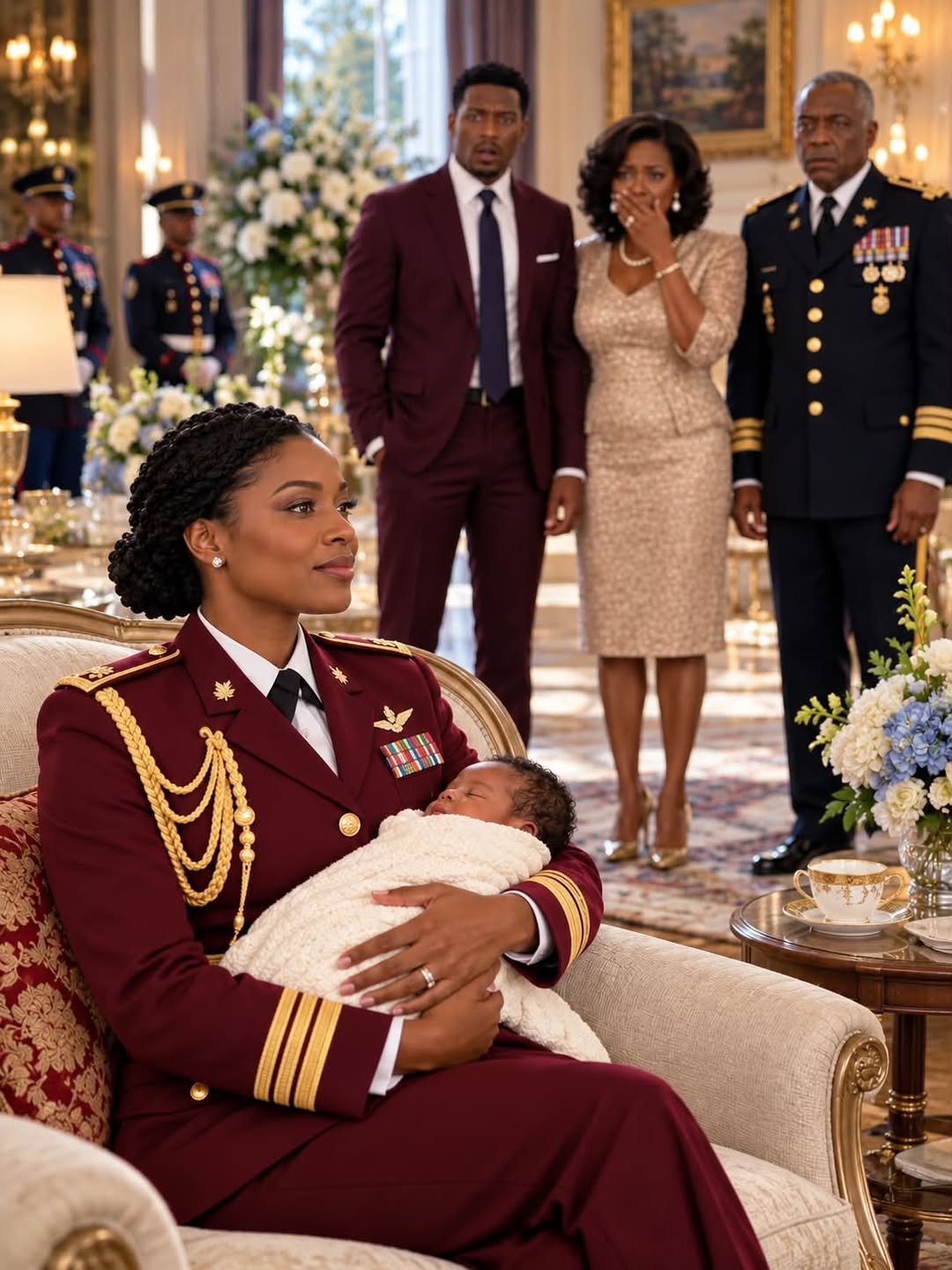
A lieutenant colonel holding a newborn.
It sounds like a revenge story.
It wasn’t.
The important moment happened two days earlier.
I stood in my kitchen.
Thirty-eight weeks pregnant.
Scared.
In pain.
And I asked the person who had promised to love me to take me to the
hospital.
He chose somewhere else.
Everything afterward came from that choice.
Not punishment.
Consequence.
There is a difference.
I did not call my commander to frighten my husband.
A hospital contacted the person I had trusted to answer.
I did not order soldiers to my house.
Coworkers volunteered to help.
I did not use rank to win a marriage argument.
My rank had almost nothing to do with the argument.
That was the lesson Marcus finally understood.
He had spent four years married to Lieutenant Colonel Nia Bennett
without really knowing Nia Bennett.
He knew the wife who fixed dinner.
The woman who remembered birthdays.
The person who rearranged schedules.
The pregnant woman he assumed would wait.
Then I stopped waiting.
For the ambulance.
For him to become curious.
For Denise to approve of me.
For strength to magically protect me from being neglected.
I called for help.
People came.
Two days later, Marcus stood in the driveway staring at the vehicles and
asked:
“Who are all these people?”
I looked down at Elijah.
Then back at my husband.
“They’re the people who showed up.”
He never forgot that sentence.
May you like
- When we were 19, my best friend and I promised that if we were both single at 60, we’d find each other I turned 60 last Tuesday, and my old landline rang.
- Five Minutes After Our Divorce, I Flew Overseas With Our Two Children Then My Ex’s Family Heard the Doctor’s Ultrasound Verdict
- My 63-year-old mother-in-law met a man on our family vacation and decided not to come home with us. Five days later, she called me at midnight and whispered, “I need you to save me. But please don’t tell my son.”
- My Husband Left Me in Labor for His Mother’s Birthday Two Days Later, Military Vehicles Filled Our Driveway
- Cop Poured His Drink on a Black Woman in Her Own Driveway Then He Learned Who She Was
Neither did I.
THE END
See more on the next page
