
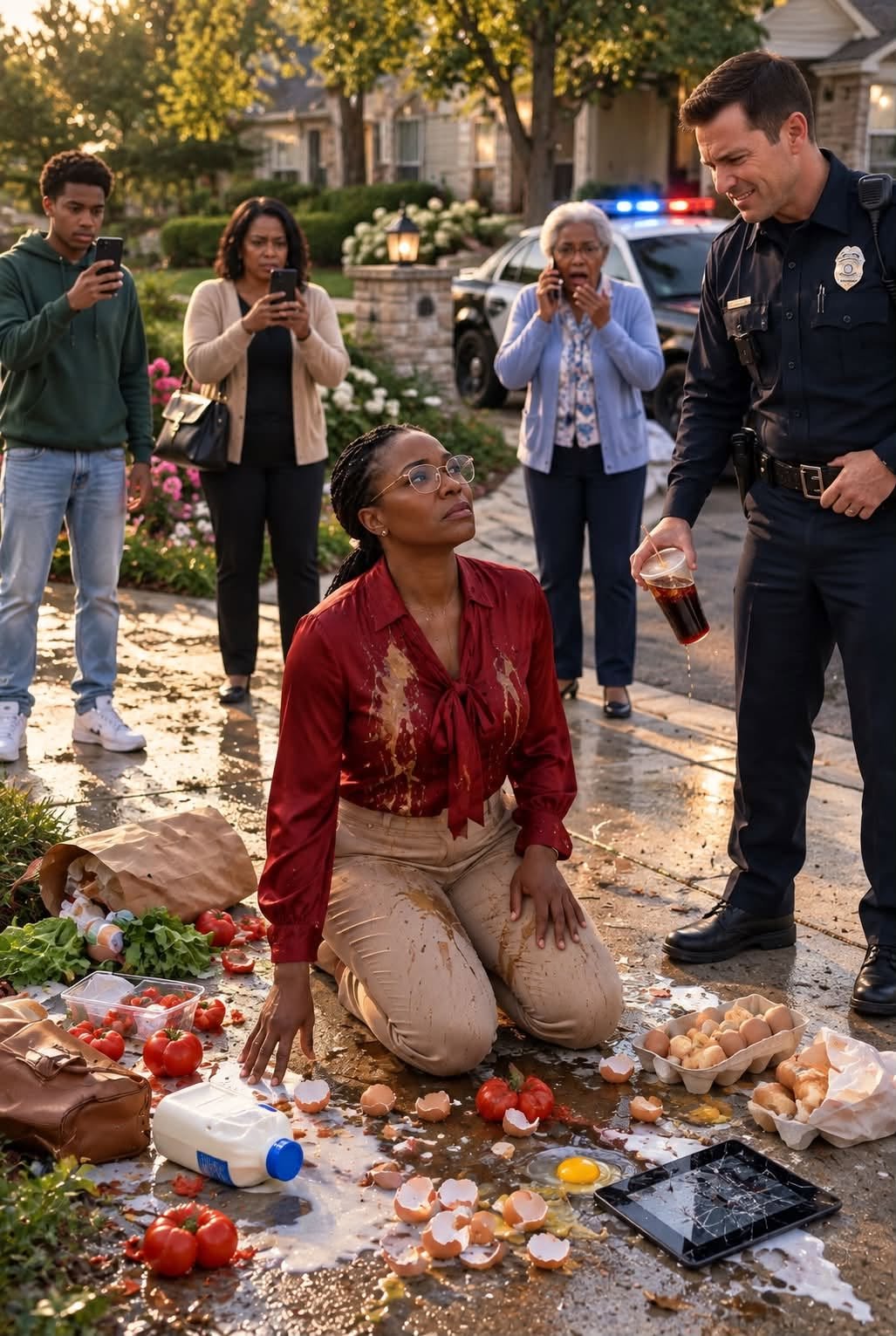
“Don’t edit it. Don’t crop it. Don’t post it. Keep the phone.”
“Okay.”
“Can you send a copy to my lawyer while preserving the original?”
“Yes.”
Ruth reached for her.
Then stopped.
“Can I hug you?”
That question nearly broke Simone.
“Yes.”
PART 10 — THE CONFLICT
Simone called outside counsel for the review panel.
Then she called the panel chair.
“I need to recuse myself from any discussion involving one officer.”
“Why?”
“I had an encounter with him today.”
Silence.
“Who?”
“Travis Cole.”
Another silence.
“What happened?”
Simone explained.
The chair swore quietly.
“We postpone.”
“No.”
“Simone—”
“The report existed before today.”
“Yes.”
“My encounter cannot become a reason to suppress findings already
supported by records.”
“It also can’t become a reason for you to appear biased.”
“Exactly. I’ll disclose the conflict and step away from any
officer-specific discussion.”
That decision mattered later.
Simone did not want anyone claiming she used the panel to punish a man
who humiliated her.
She wanted the evidence separated.
The report was one matter.
Her driveway was another.
PART 11 — MALCOLM
She called Malcolm at 12:46.
He answered immediately.
“Hey.”
“I need you not to react.”
“That sentence guarantees I’m going to react.”
“A police officer stopped me in our driveway.”
Silence.
“What?”
“He poured a drink on me.”
Malcolm stopped breathing audibly.
“Who?”
“Travis Cole.”
“I’m coming home.”
“No.”
“Simone.”
“Listen to me. You are the mayor. Do not call the chief demanding
someone be fired.”
“I wasn’t going to—”
“Yes, you were.”
He said nothing.
“Malcolm, there is video. Counsel has it. The department needs to follow
its process. If you interfere, you make this about you.”
“He humiliated my wife.”
“I know.”
“On our property.”
“I know.”
His voice broke.
“Are you okay?”
That was when Simone finally cried.
“No.”
PART 12 — THREE O’CLOCK
At three, the municipal chamber was packed.
The meeting had already attracted reporters because the independent
review concerned police accountability.
Simone changed into a navy suit.
She considered staying home.
Then she decided to attend long enough to make a disclosure.
Malcolm sat at the dais.
Police Chief Elaine Donovan sat several seats away.
Union representatives filled one row.
Residents filled the others.
Travis Cole arrived in uniform.
He had been directed to attend because supervisors whose units were
discussed in the report were present.
He walked into the chamber talking to another officer.
Then he saw Simone.
She sat behind a placard:
DR. SIMONE BENNETT INDEPENDENT CIVIL RIGHTS ADVISORY PANEL
Travis stopped.
His face drained.
He looked toward Malcolm.
Then back at Simone.
The connection landed.
Mayor Bennett.
Simone Bennett.
The woman in the driveway.
His knees did not literally collapse.
But he grabbed the back of a chair as though the room had shifted
beneath him.
PART 13 — DISCLOSURE
The panel chair opened the meeting.
Before findings were presented, Simone requested the microphone.
“My name is Simone Bennett. I served as one of five advisers to this
independent review.”
The room quieted.
“This afternoon, before this meeting, I had an encounter with an officer
whose prior complaint history is referenced in the underlying
materials.”
Travis stared forward.
“Because that creates an actual or perceived conflict, I have recused
myself from any discussion or recommendation specific to that officer.”
A reporter’s hand shot up.
The chair reminded everyone there would be questions later.
Simone continued.
“The panel’s work predates today. I will not use this forum to
adjudicate my personal complaint.”
Then she sat.
Travis looked confused.
Perhaps he expected revenge.
He was about to discover something worse.
Procedure.
PART 14 — THE REPORT
The panel’s findings were presented by Professor Daniel Shaw, another
adviser.
The report identified weaknesses in complaint tracking.
Supervisors sometimes evaluated incidents individually without seeing
repeated patterns across time.
Body-camera activation rules were inconsistently enforced.
Some disciplinary records were difficult to compare.
The department had improved training but lacked a reliable early-warning
system.
Then Daniel discussed anonymized case clusters.
One cluster involved multiple allegations against the same patrol
officer.
He did not initially name Travis.
The pattern existed before Simone’s driveway.
That mattered.
Chief Donovan looked increasingly uncomfortable.
The union attorney took notes.
Malcolm said nothing.
Simone kept her hands folded.
PART 15 — THE VIDEO
The neighbor’s video was not publicly played during the hearing.
It was evidence in a new complaint and potentially other proceedings.
But news traveled quickly.
Ruth had provided the original through proper channels.
The police department opened an internal investigation.
An outside agency was asked to review aspects of the incident because of
Simone’s marriage to the mayor and her role on the advisory panel.
That separation protected everyone.
Including Travis.
By evening, reporters knew something had happened.
Simone released only a short statement:
“I experienced an encounter today that is under review. I will respect
the investigative process and will not use my husband’s office or my
advisory role to seek special treatment.”
Then Ruth called.
“People are asking me for the video.”
“Please talk to counsel before doing anything.”
“I will.”
Two days later, after legal consultation and once preservation needs
were addressed, Ruth chose to release her recording publicly.
The city exploded.
PART 16 — “STAY DOWN THERE”
The clip lasted less than four minutes.
Millions of people eventually watched it.
The most replayed moment was not the soda.
It was Travis saying:
“Stay down there where you belong.”
Commentators argued about context.
Some defended him.
Some condemned him.
Some claimed Simone had provoked the stop.
Others noted that asking why you are detained is not the same as
threatening an officer.
The department released dispatch information showing a
suspicious-vehicle call had occurred.
It also acknowledged that the vehicle description was not an exact match
for Simone’s SUV.
Simone refused television interviews for the first week.
She did not want her humiliation turned into entertainment.
At home, Jordan saw the video anyway.
His face changed.
“Mom.”
“I know.”
“He made you kneel.”
“Yes.”
“Why didn’t you tell me?”
“Because I wanted to tell you when I could sit beside you.”
Jordan started crying.
Then he became angry.
“I hate him.”
Simone took his hands.
“You are allowed to hate what he did.”
“That’s not what I said.”
“I know.”
PART 17 — THE BODY CAMERA
Travis’s body camera became another important piece of evidence.
There were questions about when it was activated and what portions of
the encounter it captured.
Investigators compared it with dispatch logs, Ruth’s video, radio
traffic, and statements.
Simone did not speculate publicly.
She had spent too much of her career criticizing institutions for
reaching conclusions before evidence was complete.
She would not abandon that principle because she was now the person
harmed.
Privately, however, she struggled.
Calm in public did not mean calm at home.
She woke at night hearing:
Stay down there.
She stopped parking in the driveway for two weeks.
Once, a police cruiser passed while she was taking out trash.
Her entire body tightened.
Trauma did not care that she understood procedure.
PART 18 — TRAVIS’S HISTORY
The independent investigation reviewed Travis’s prior complaints.
Not every allegation was substantiated.
That remained true.
But supervisors were asked why repeated concerns had not triggered
closer review earlier.
One former sergeant said he had recommended additional intervention.
Another supervisor disagreed.
Training records were examined.
Performance evaluations were reviewed.
The union argued that public outrage should not replace due process.
Simone agreed with that sentence.
She also believed due process should not become a synonym for doing
nothing.
Both ideas could coexist.
PART 19 — THE CALLER
Investigators eventually identified the original caller.
It was not someone from Simone’s street.
The caller had reported a dark vehicle moving slowly several blocks
away.
There was no report of a Black woman stealing groceries.
No report that someone had entered Simone’s property.
No description matching Simone’s clothing.
That did not mean Travis had no basis to ask questions when he saw a
vehicle he considered potentially relevant.
It did raise serious questions about how an inquiry became humiliation.
The central issue was no longer whether he had permission to speak to
her.
See more on the next page
