
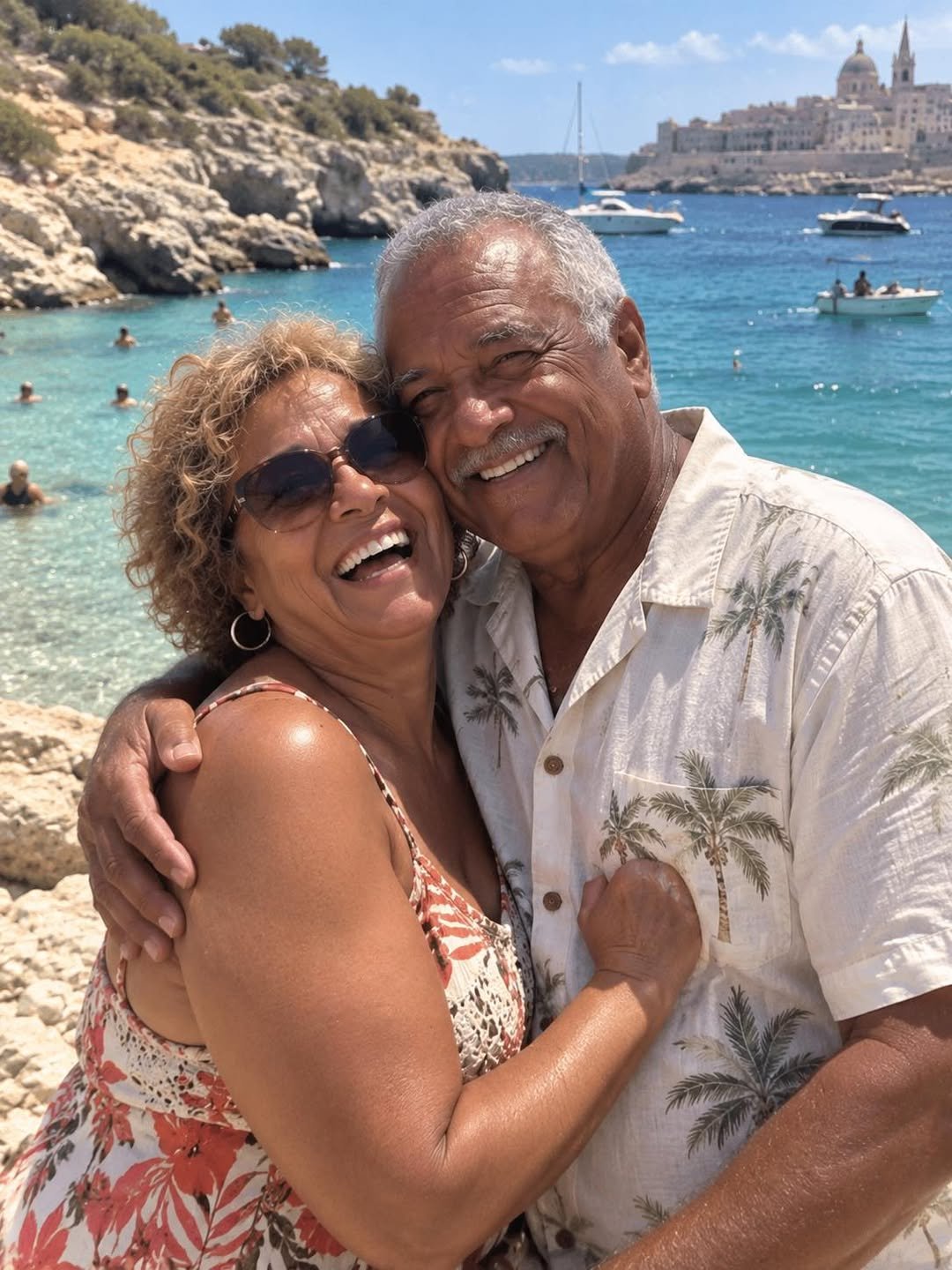
“David,” I said gently. “The waiter said ‘again.’ You told me you’d never been here.”
His face fell. He’d been caught, and I watched him decide, in real time, whether to keep the small lie or tell me the enormous truth.
He chose the truth. He was, I was learning, a man who chose the truth even when it cost him.
“I’ve been here once,” he said quietly. “Three years ago. With my wife. Margaret. Six months before she passed. It was our favorite place in Valletta.
I haven’t been able to walk through that door since. I’ve tried. I get to the entrance and I turn around.
But tonight, I wanted to bring you somewhere that meant something. And this is the place that means the most. So I made myself come in. With you.
I lied about never having been here because I didn’t know how to explain all that without — without making our last night about my grief instead of about you. I’m sorry. It was a coward’s lie. I should have just told you.”
I reached across the table and took his hand.
“David,” I said. “I heard you. In the courtyard. On the phone with your daughter.
I heard all of it.”
He went very still.
“I heard you ask her permission to be happy again. I heard you ask if Margaret would have liked me. I heard you thank her for giving you permission to live a little longer.
I wasn’t going to tell you I heard. But I don’t want to start whatever this is with a secret between us, even a kind one.
You didn’t lie to me tonight, David. You did the most honest thing I’ve ever seen anyone do. You brought me into the holiest room in your heart. You didn’t hide your wife from me. You introduced me to her.
And I want you to know something.”
I held his hand tighter.
“I said yes to everything this week. Yes to strange food, yes to boats, yes to a man with an upside-down map — no, that was me with the map. Yes to life.
The biggest yes I have left in me is this:
Yes, David. Whatever you were going to ask me. Before you even ask it.
Yes.”
PART 4
He laughed, and cried, and laughed again, and then he asked me.
Not to marry him. He was too sensible for that, and so was I; we were seventy and sixty-seven, not seventeen.
“Stay,” he said. “Not forever — I won’t ask for forever, we haven’t earned forever yet. But don’t let tomorrow be goodbye. Change your flight. Stay another week. And then let’s see each other again. And again. Let’s find out if this old thing between us is real, slowly, the way careful people do it.
I spent three years thinking my story was over. That the good part was behind me and all that was left was the quiet.
Then a woman walked into me on a street in Valletta with her map upside down, and I remembered that I’m not dead yet.
Stay a while, Eleanor.
Let’s not be done.”
I stayed.
I changed my flight. I called my daughter — the one who’d asked me when I’d last done something that made me happy — and I told her I was staying another week in Malta with a man named David, and she cried, the good kind of crying, and said, “Mom. YES. Finally. Yes.”
David and I spent that second week the way we’d spent the first, but slower, deeper, with the truth between us instead of a careful lie. He took me to all the places he’d loved with Margaret, and instead of it being sad, it was a gift — he was letting me know the whole of him, the loved and the lost and the still-alive.
I told him about my husband, too. Forty years. The life we built, the quiet after. I’d thought, like David, that my story was over.
We were two people who’d been certain the good part was behind them, discovering, at sixty-seven and seventy, that hearts don’t run out of room. They just wait for someone to open the door again.
“Margaret would have liked you,” David told me one evening, by the sea. “My daughter’s right. She’d have liked you very much. She’d have liked that you say yes.”
“My husband would have liked you,” I said. “He always wished I’d say yes more. He’d be glad someone finally got me onto a boat.”
We laughed. We sat with our ghosts, side by side, and our ghosts didn’t mind. That’s the thing nobody tells you about loving again after loss — the people you loved don’t compete with the people you love. If they loved you truly, they’re rooting for you. They gave you permission a long time ago. Sometimes you just need to hear it in a courtyard, on a phone, to believe it.
PART 5 — FINAL
That was two years ago.
David and I are still together. Slowly. Carefully. The way careful people fall in love when they’ve already learned how much there is to lose.
We split our time now — a few months in Malta, where he lives, a few months near my daughter, who adores him. We’re not married. We might be, someday. We’re in no hurry. We’ve both already had the great marriages of our young lives, and this is something different — a companionship in the last chapter, gentler and more grateful than the loves of our youth, because we know exactly what it’s worth.
Our children — his daughter, my daughter — have become friends. They text each other about us, conspiratorially, like parents watching teenagers. “Are they holding hands again?” “He bought her flowers, I can’t.” They’re delighted, both of them, that their widowed parents found each other. There’s a particular joy in watching your child be happy that you’re happy. I didn’t know about that joy until now.
We went back to the restaurant. The one overlooking the harbor. Mr. Bennett’s table.
We go every year now, on the anniversary of the night I followed him and heard the truth. We order what he and Margaret used to order, and what my husband and I used to order, and we toast them both — the two people who loved us first, who taught us how to love, who would both, we’re certain, be glad.
“To Margaret,” I say.
“To your Robert,” David says.
“To the room they left in our hearts,” we say together, “that turned out to be big enough for one more.”
Here’s what I learned, at sixty-seven, with an upside-down map and a promise to say yes.
I spent my whole life choosing the safe path. And it was fine. It was a good life, a safe life, and I don’t regret it. But safe is not the same as full, and I’d forgotten, somewhere in all that safety, that the whole point of a life is to be lived.
My daughter’s question cracked me open. “When was the last time you did something just because it made you happy?”
The answer, it turned out, was waiting on a street in Valletta, in a man with a kind face who laughed when I bumped into him.
I almost didn’t go to Malta. I almost said no, the way I’d said no to everything for sixty-seven years.
I almost stayed small and safe and alone.
Instead I said yes.
Yes to the trip. Yes to the stranger. Yes to the ferry and the coffee and the sea. And yes, on my last night, to following him — to walking toward the truth instead of away from it, the way the old me would have.
And the truth was the most beautiful thing I ever heard.
A grieving man asking permission to be happy again.
And receiving it.
And then offering that same happiness to me.
I say yes now. It’s my whole philosophy, at sixty-nine. Say yes to the trip, the stranger, the second chance, the open door. Say yes to the room in your heart you thought was closed.
It’s bigger than you think.
There’s always room for one more yes.
David proved it to me, in a courtyard, in Malta, on the night I was brave enough to follow him.
The night my story, which I was so sure was over, turned out to be just getting to the good part.
Yes.
Always, from now on—
May you like
- At 68 My Daughter Told Me to Cover Up at Her Pool Party Then Her Husband
- My Bullied Daughter’s Entire Class Suddenly Visited Her in the Hospital
- My mother-in-law turned up on my porch with three suitcases and called the police when I wouldn’t let her in
- My Husband Brought a Homeless Woman Into Our House and Told Me Not the Staff to Bathe Her
- THEY OFFERED ME $200,000 TO SIGN AWAY MY NEWBORN TWINS BY SUNRISE, THAT SIGNATURE HAD BROUGHT DOWN AN ENTIRE FAMILY EMPIRE
yes.
THE END
See more on the next page
