A 10-pound baby was trapped inside me, my blood pressure was beginning to fail, and the doctor refusing me an emergency C-section was my own husband. Then Preston looked at the anesthesiologist and gave the order that destroyed whatever love I still had for him: “Turn off the epidural.”
For a moment, the delivery room went unnaturally quiet. Even the assisting nurse stared at him in disbelief before glancing at the monitors and saying, “Dr. Pierce, the baby’s measurements are far beyond the expected range. Her vitals are deteriorating. We need to consider an emergency C-section before this becomes critical.”
Preston didn’t even hesitate. “I’m the attending physician. I’ll decide how my son is delivered.”
Hearing him call the baby his son while treating me like nothing more than a difficult patient made something inside me go cold. I was Elena Vance, chief of emergency medicine, and I’d spent years recognizing the warning signs of medical disasters, yet now I was lying beneath those blinding surgical lights while one unfolded inside my own body.
Every contraction felt like my pelvis was being torn apart from the inside. Sweat soaked through my gown, my muscles shook uncontrollably, and I could barely force out the words, “Preston, he can’t fit. My uterus is under too much stress. Please don’t do this.”
My husband finally looked at me, but I saw no fear in his eyes. No tenderness, no concern, just irritation as he said, “Elena, stop trying to run my delivery room the way you run your ER.”
Then Khloe stepped beside him.
His young female intern wore the wounded expression I’d come to recognize far too well. With tears shining in her eyes, she whispered, “Dr. Pierce, please don’t be angry with Dr. Vance. She only knocked over my medication tray because she’s in so much pain. I’m sure she didn’t mean it.”
I stared at her, stunned by how easily the lie came out. Less than a minute earlier, she’d leaned over me pretending to wipe sweat from my forehead, then deliberately dug her sharpened nails into the tender skin inside my arm until I jerked away and knocked the tray over.
Preston never asked what had happened. He simply believed her, and when he looked at Khloe, his expression softened in a way I couldn’t remember him looking at me in years.
Seven years of marriage suddenly rearranged themselves in my mind. This wasn’t two doctors disagreeing about treatment anymore because I was frightened, helpless, and begging the man who’d promised to protect me to listen, while he’d already decided her accusation mattered more than my pain.
“Hold her still,” Preston ordered.
Three nurses hesitated, and one finally protested, “Doctor, this isn’t consistent with protocol.” Preston’s jaw tightened as he replied, “If anything happens, I’ll take responsibility.”
Then hands closed around my shoulders and legs. They were gentle hands, almost apologetic, but there was no escaping the truth that I was being restrained while my husband stood over me.
I stopped pleading with him after that. I stopped trying to remind Preston that I was his wife and poured every breath I had left into one desperate thought: please let my son survive this.
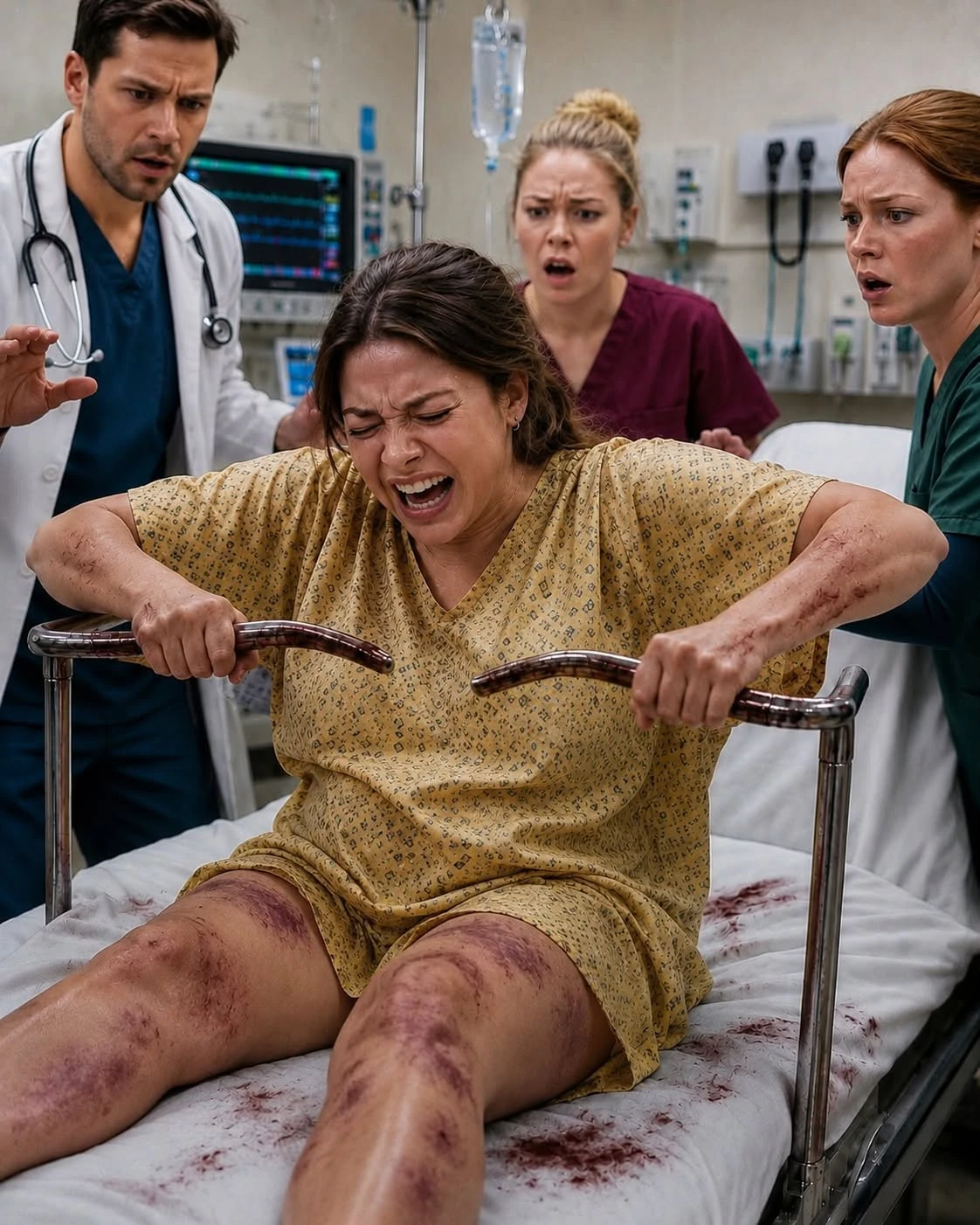
Another contraction ripped through me, harder than anything before it. I grabbed the stainless-steel bed rail and squeezed until a violent crack echoed through the room.
The rail snapped in my hand.
Everyone froze as the jagged metal sliced my palm and blood spotted the white sheet. Preston looked shaken for one brief second, and I searched his face, praying that seeing what the pain was doing to me would finally bring my husband back.
Instead, his expression hardened. “If you put that much effort into pushing instead of making a spectacle, our son would already be here.”
Something inside me broke more completely than that railing.
Then, after what felt like an eternity, a tiny cry pierced the chaos. “It’s a boy,” a nurse whispered, and relief crashed through me so powerfully that tears filled my eyes because, for one precious heartbeat, knowing my baby was alive was enough.
Then I saw the nurse’s face change.
Her eyes snapped toward the monitor, all the color draining from her cheeks as she whispered, “Dr. Pierce…”
My blood pressure was crashing.
Alarms screamed around me as nurses suddenly rushed toward the bed. Through the blur, I saw Preston staring at the numbers he’d refused to fear until now, and for the first time that night, absolute panic appeared on my husband’s face.
Then my vision began to disappear.
The last thing Elena Vance remembered was the shriek of the monitors and the sudden, terrifying emptiness where her vision used to be.
She woke to a different kind of light.
Not the brutal overhead lamps of Labor and Delivery, but the softer, filtered glow of an ICU bay at 4:17 a.m. The clock on the wall told her that much. Everything else had to be assembled piece by piece: the burn in her throat from the endotracheal tube that had already been removed, the heavy pressure of an abdominal binder, the dull roar of pain that lived somewhere beneath the morphine, the rhythmic hiss of the blood-pressure cuff cycling on her left arm.
Her right hand was wrapped in thick gauze. She flexed her fingers and felt the pull of sutures. The railing. She had broken the railing.
A nurse she did not recognize leaned into view. “Dr. Vance. You’re in the ICU. You had an emergency hysterectomy and massive transfusion. You’re stable now. Your son is in the NICU. He’s doing well.”
Elena’s mouth was desert-dry. The words that came out were sandpaper.
“How long?”
“Thirty-one hours since delivery.”
Thirty-one hours. An entire day and night had been stolen from her.
She turned her head toward the window. Rain streaked the glass. Seattle in late October. The city she had chosen, the hospital she had helped build a reputation inside, the marriage she had believed would last.
None of it felt like hers anymore.
The nurse adjusted a pump. “Dr. Pierce has been in and out. He left about an hour ago. He said to call him the moment you woke.”
Elena closed her eyes. “Don’t.”
The nurse hesitated, then nodded once, as if she had been waiting for permission to stop pretending.
—
They named the baby Alexander James Vance.
Elena learned this from the neonatologist who wheeled the isolette into her room on the third afternoon, after she had been moved out of the ICU and into a private suite on the postpartum floor that no one quite knew how to classify. She was neither a typical postpartum patient nor a typical surgical one. She was the chief of emergency medicine who had nearly died in her own hospital while her husband delivered their son against every warning the room had given him.
Alexander weighed nine pounds, fourteen ounces. His Apgar scores had been decent after the first frantic minutes. He had a faint bruise along one cheek and a tiny abrasion on his scalp. He was perfect in the way only a baby who has survived something he should never have been asked to survive can look perfect.
Elena could not hold him yet. The incision, the anemia, the residual weakness in her arms made even sitting upright an act of will. A nurse positioned the isolette so that Elena could reach through the port and rest two fingers against her son’s chest. His heartbeat was a small, furious drum.
She spoke to him the way she had spoken to crashing patients for fifteen years: low, precise, without panic.
“You’re here. That’s the only thing that matters right now.”
Alexander’s mouth worked around a phantom nipple. His eyes were still the dark, unfocused navy of newborns. Elena stared at him until the nurse quietly suggested she rest.
She did not rest.
—
Preston came that evening.
He looked like a man who had not slept and had chosen expensive clothes anyway. Charcoal slacks, a pale blue shirt with the sleeves rolled just so, the wedding band still on his left hand. He closed the door with the careful quiet of someone who believed the room still belonged to him.
“Elena.”
She did not look away from the isolette.
“You should have called me,” he said. “I wanted to be here when you woke up.”
“You were here when I almost didn’t.”
The silence that followed had weight. Preston sat in the visitor chair without being invited. He leaned forward, elbows on his knees, the posture he used when delivering bad news to families.
“The baby is healthy. That’s what matters. I made the call I thought was right in the moment. Macrosomia isn’t an automatic indication for section. You know that.”
May you like
- My Son Held His Premature Baby at Graduation—Then His First Words Silenced an Entire Auditorium
- My Husband Wanted My House, My Company, and Our Children—Then I Opened My Handbag in Court
- My Dad Charged Me $250 a Month to Live at Home—After His Death, I Discovered Why
- My Husband Moved His Mother Into My House Without Permission—By Sunrise, They Were Begging Me to Let Them Stay
- My Parents Sued Me for My Grandmother’s $4.7 Million Inheritance—Then the Judge Recognized My Military Rank
“A ten-pound baby with a failing second stage and a mother whose blood pressure was falling is an indication,” Elena said. Her voice was flat. “You turned off my epidural. You restrained me. You let an intern lie about why a tray hit the floor.”
Preston’s jaw tightened. “Khloe was trying to help. You were out of control.”
“I was in labor with a baby that would not fit. I was your wife.”
He stood. The chair legs scraped. “I will not have this conversation while you’re on narcotics and looking for someone to blame. I saved our son. The hysterectomy was unfortunate, but it saved your life. You should be thanking the team instead of rewriting the night into a morality play.”
See more on the next page
