
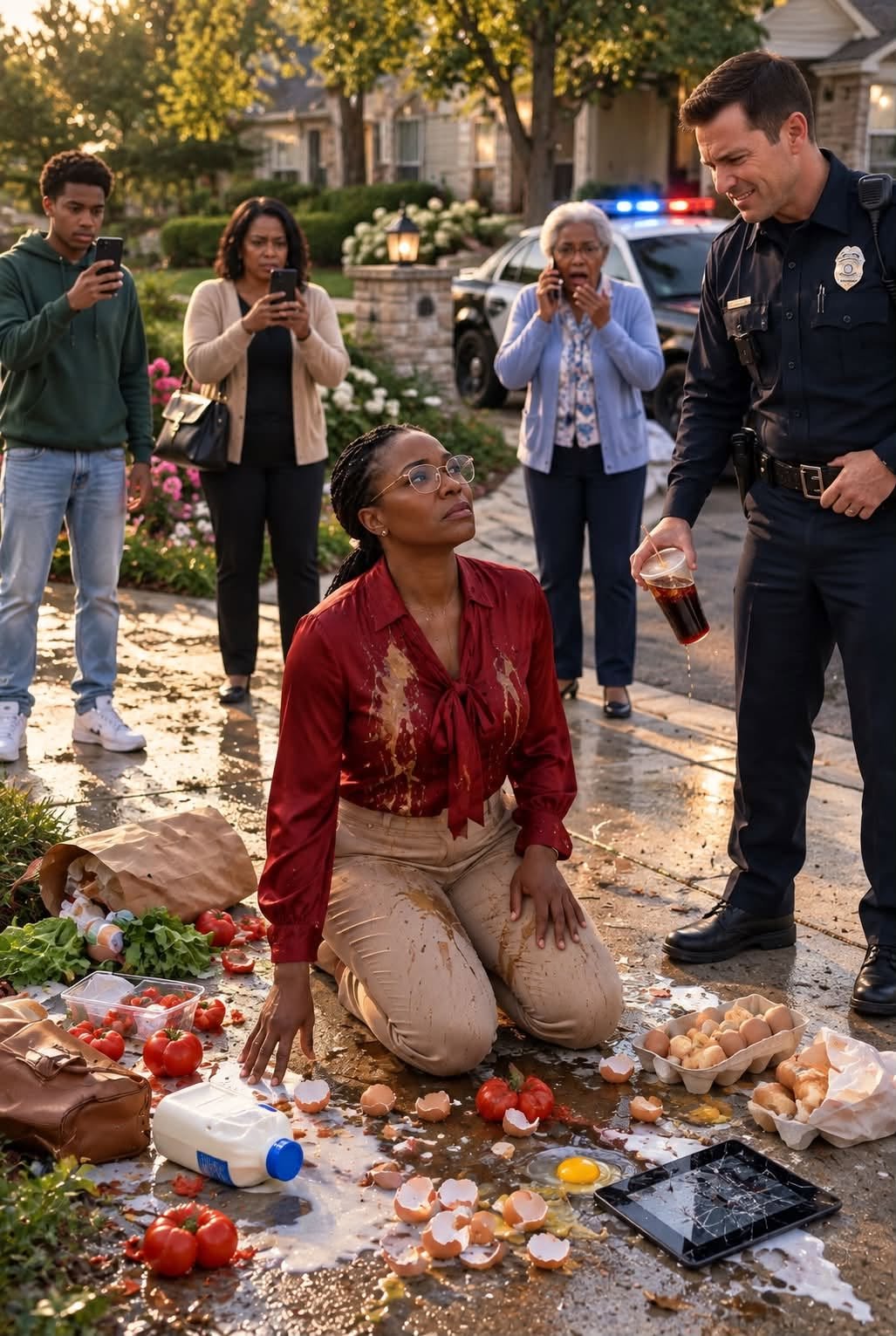
COP POURED HIS DRINK ON A BLACK WOMAN IN HER OWN DRIVEWAY—THEN HE
LEARNED WHO SHE WAS
PART 1 — EIGHT FEET FROM HOME
“Get on your knees and pick up this mess.”
The woman’s voice barely rose above a whisper.
“Officer, please. This is my home.”
“I don’t care what you were doing.”
Officer Travis Cole tilted the enormous soda cup in his hand.
Cold liquid spilled over Dr. Simone Bennett’s shoulder, soaking the
front of her cream blouse and running down onto the concrete driveway.
For a second, nobody moved.
Then Travis pointed at the groceries scattered around her feet.
“People like you need to learn respect when a badge is talking.”
Simone stared at him.
Her front door was eight feet away.
Her keys lay beside a broken carton of eggs.
Tomatoes had rolled beneath her car.
A paper grocery bag had split open when Travis knocked it from her
hands.
Across the street, seventy-year-old Ruth Calder stood behind a hedge
holding her phone.
Recording.
Simone saw her.
Travis did not.
“Pick it up,” he repeated.
Simone slowly knelt.
Not because Travis had earned obedience.
Because she had spent fifteen years telling frightened clients that
surviving the moment mattered more than winning the argument inside it.
She gathered the groceries.
Travis smiled.
“That’s better.”
Then he said something Ruth’s phone captured clearly.
“Stay down there where you belong.”
Simone’s expression changed.
Only slightly.
She reached for her keys.
Travis finally noticed the expensive house behind her.
His eyes narrowed.
“You live here?”
“Yes.”
“Prove it.”
Simone held up the keys.
“You asked whether I live here. I answered.”
“I said prove it.”
She looked at his badge.
Travis Cole.
Number 417.
Simone memorized it.
Then she asked:
“Officer, are you finished?”
He had no idea who she was.
That was about to matter.
But not for the reason he would later claim.
PART 2 — BREAKFAST
Six hours earlier, the Bennett kitchen smelled of coffee, toast, and
cinnamon.
Simone stood at the stove making eggs.
Her husband, Malcolm Bennett, entered wearing a navy suit and carrying
two folders.
Their sixteen-year-old son, Jordan, sat at the island pretending to
study chemistry while texting.
Their fourteen-year-old daughter, Nia, was searching for a missing
soccer cleat.
“Mom,” Jordan said, “can I use the car tonight?”
“You mean my car?”
“Temporarily our car.”
“No.”
Malcolm laughed.
Jordan pointed at him.
“Dad?”
“Ask your mother.”
“I just did.”
“Then democracy has spoken.”
It was ordinary.
That was what Simone remembered later.
The morning had been painfully ordinary.
Malcolm poured coffee.
“Three o’clock,” he said.
“I know.”
“You ready?”
“No.”
“Good.”
Simone looked at him.
“Good?”
“You’re always terrifying when you say you’re not ready.”
Malcolm was mayor of Bellhaven, Virginia.
Simone was not employed by his administration.
That separation mattered to both of them.
She was a civil-rights attorney and former federal prosecutor who now
led a small legal institute specializing in police accountability,
public-sector compliance, and constitutional litigation.
Six months earlier, Bellhaven’s city council had authorized an
independent review of complaint procedures inside the police department.
Because Malcolm’s wife was a prominent attorney, Simone initially
refused any involvement.
Then the council created an independent advisory panel, retained outside
ethics counsel, and asked Simone to serve as one of five unpaid
subject-matter advisers.
She agreed only after the city attorney confirmed the structure
publicly.
That afternoon, the panel’s findings were scheduled for presentation.
The report did not decide whether individual officers were guilty of
misconduct.
It examined patterns.
Complaint handling.
Supervision.
Discipline.
Body-camera compliance.
Repeated allegations involving the same officers.
One name appeared more than once.
Travis Cole.
PART 3 — THE COMPLAINTS
Simone had never met him.
That point would become important.
The report included four prior complaints connected to Cole over three
years.
One alleged an unnecessary detention.
Another alleged insulting language during a traffic stop.
A third involved disputed force during an arrest.
A fourth claimed Cole had threatened a teenager who questioned why his
backpack was being searched.
Some allegations had been closed as unsubstantiated.
One resulted in counseling.
Another remained under review.
The independent panel did not declare Cole guilty based on complaints
alone.
Simone had insisted on that language.
“A complaint is not a conviction,” she told the panel. “But repeated
complaints can still reveal where supervision needs attention.”
The report criticized the department’s system for identifying patterns.
That was the point.
Not revenge.
Not politics.
Systems.
Malcolm had read none of the confidential draft.
Simone had refused to discuss it with him.
At breakfast, he asked only:
“Is today going to be ugly?”
“Yes.”
“Anything I should know?”
“You should know your coffee is getting cold.”
He smiled.
“Attorney-client privilege?”
“Marriage-preservation privilege.”
He kissed her forehead.
At 7:20, everyone left.
By noon, Simone had no idea the man whose name appeared in the report
would be standing in her driveway.
PART 4 — THE GROCERY STORE
Simone left her office shortly after eleven.
The hearing would begin at three.
She wanted an hour at home to change clothes and review notes.
She stopped at Hawthorne Market because Nia had texted:
WE HAVE NO TOMATOES.
This was objectively false.
They probably had tomatoes.
See more on the next page
